Showing posts with label Kazakhstan. Show all posts

Sunday, May 31, 2015

DTN News - RUSSIAN DEFENSE NEWS: KAMAZ-63968 Typhoon-K MRAP

DTN News - RUSSIAN DEFENSE NEWS: KAMAZ-63968 Typhoon-K MRAP 
Source: DTN News - - This article compiled by K. V. Seth from reliable sources Defense News
(NSI News Source Info) TORONTO, Canada - May 31, 2015: Kamaz Typhoon is a family of Russian multi-functional, modular, armoured, mine resistant MRAP vehicles. The Typhoon family is part of Russia's Typhoon program launched in 2010. Both Kamaz and Gaz-Group are taking part in Typhoon program and develop their own family of vehicles. 

Kamaz already develop the KAMAZ-53949 Typhoon-K 4x4 modular armoured and Gaz the Ural Typhoon 6x6 multi-purpose armoured truck. Kamaz-63968 6x6 Typhoon-K (Taifun) has a mass of 21 tonnes and can carry up to 16 people in its personnel compartment.

Kamaz-63969 Typhoon is an advanced, special-purpose mine-resistant armoured wheeled vehicle designed and manufactured by KAMAZ, a truck maker based in Russia, for the Russian Army.

The new generation 6x6 armoured vehicle can be deployed in reconnaissance, surveillance, command and staff, engineer reconnaissance, medical evacuation, nuclear, biological and chemical (NBC) reconnaissance and surveillance, fire support, special attack and armed escort missions.

The Typhoon MRAP can also be used to convoy other vehicles for combat missions and to transport soldiers, medical units and other equipment. It offers increased protection for troops in high threat environments.

The Kamaz Typhoon family of 6x6 armoured vehicles also consists of Kamaz-63968 (Typhoon-K) vehicle, which can accommodate two crew and up to 16 troops. The vehicle took part in the Interpolitex-2013 security exhibition in October 2013. A total of 14 Typhoon-K vehicles participated in Russian Victory Day military parade held in May 2014 in Moscow.

The Kamaz-63969 armoured vehicle has been developed under the Typhoon (Tayfun) MRAP programme, which is part of the Russian Federation Armed Forces' plan to produce military vehicles for the period up to 2020. The programme was initiated in January 2010. The Typhoon was originally demonstrated during an exhibition in Bronnizy, Russia in 2011.

The first prototype was completed and demonstrated to the Russian military department in June 2013. The Kamaz-63969 was also exhibited during the Russian Arms Expo (RAE) 2013 and the Kazakhstan Defence Expo (KADEX) 2014.

Kamaz-63969 Typhoon design and features
The Kamaz-63969 MRAP-type vehicle features monocoque hull made from new armoured steel. It incorporates on-board information systems, control units, sensors and a number of advanced defence solutions.

The armoured vehicle is 7.8m long, 2.52m wide and 2.75m high. It has a kerb weight of 19,703kg and a gross weight of 23,703kg.

The Typhoon can carry two crew and up to ten soldiers. Its cockpit is fitted with two monitors to display the information of the vehicle. The functional area is also fitted with a monitor.

Armament of Kamaz-63969
The Kamaz-63969 Typhoon is armed with a remotely controlled weapon system provided by Elektromashina JSC. The weapon station is mounted with PKT machine guns with the Russian 7.62?54mmR calibre rounds.

A rocket propelled 30mm AGS-30 automatic grenade launcher can also be mounted on the weapon station. It can store up to 30 rounds of ammunition and can fire belt-fed GPD-30, VOG-30 and VOG-17M 30mm grenade rounds at a rate of 400 rounds per minute. The 16.5kg grenade launcher is fitted with a day-night sight and has an effective firing range of 2,100m.

Protection features of Kamaz-63969 Typhoon
The versatile Kamaz-63969 Typhoon armoured vehicle is equipped with enhanced protection features. It is built using integrated ceramic armour for all-round protection against 14.5mm bullets, B-32 armour-piercing shells and high-explosive armour-piercing incendiary bullets.

The vehicle also features glass cover and bulletproof windows for protection against large-calibre firearms in the combat environment. The mine resistant seats provide enhanced protection to the crew and troops against land mines. The vehicle can also be protected from blast effects equivalent to 8kg of TNT.

Kamaz-63969 engine and mobility
The 6x6 Kamaz-63969 Typhoon vehicle is powered by KAMAZ 740/354-450, V8 diesel engine that generates a maximum output power of 330.9kW and a maximum torque of 190kgm. It is also equipped with independent, hydropneumatic suspension and automatic transmission system.

The vehicle is fitted with 10.00-20 wheels and 16.00 R20 bullet-resistant tires with blast-resistant inserts. It can attain a maximum speed of 105km/h on road and has a ground clearance of 0.47m and gradient of 60%. The maximum range of the Kamaz-63969 is 1,200km.
*Contents - Army-Technology.com

*KAMAZ-63968 Typhoon-K MRAP - Realted Images


*Link for This article compiled by K. V. Seth from reliable sources Defense News
*Speaking Image - Creation of DTN News ~ Defense Technology News 
*Photograph: IPF (International Pool of Friends) + DTN News / otherwise source stated
*This article is being posted from Toronto, Canada By DTN News ~ Defense-Technology News Contact:dtnnews@ymail.com 
©COPYRIGHT (C) DTN NEWS DEFENSE-TECHNOLOGY NEWS

Monday, June 10, 2013

DTN News - RUSSIA DEFENSE NEWS: ‘Missile Defense Killer’- Russia Finalizes Testing On Prototype ICBM

Defense News: DTN News - RUSSIA DEFENSE NEWS: ‘Missile Defense Killer’- Russia Finalizes Testing On Prototype ICBM
Source: DTN News - - This article compiled by Roger Smith from reliable sources Russia Today
(NSI News Source Info) TORONTO, Canada - June 10, 2013: Russia’s Strategic Missile Forces have reported a successful launch of a next-generation ICBM that can supposedly pierce any anti-ballistic missile (ABM) system. The test came after the US announced it would resume its ABM program in Europe.


The test missile launched from a mobile pad at 9:45pm (17:45 GMT) on Thursday, the Defense Ministry said Friday. The test was carried out in the Astrakhan region, deep inside Russian territory, and the prototype’s payload successfully hit the Balkhash range in Kazakhstan.
“The test launch was a success as the [simulated] warhead hit a designated target within the set timeframe,” the Russian Defense Ministry statement said. “This test launch was intended to confirm technical characteristics of the missile, as well as to check the safety of the launch procedures and equipment.”
The launch was the fourth successful test of the prototype ICBM. The development of a new solid-fuel ICBM was officially announced in 2012, and is set to gradually replace the existing Topol-M and later the recently developed Yars missile complex. 
Russia will put the new strategic missile complex on combat alert by the end of the year, and deployment of the first regiment will start in 2014, announced the Head of the Main Operations Directorate of the Joint Staff Colonel-General, Vladimir Zarudnitsky.
He made the remarks during a meeting with Russian President Vladimir Putin about assigning officers to higher military ranks.
"In the framework of the approved plan of development of the armed forces of the Russian Federation last night we conducted a test launch of the perspective intercontinental ballistic missile complex Rubezh (‘frontier’) with increased accuracy," Zarudnitsky said, adding that the test launch was ordered to work out "the new combat equipment."
"We assess the launch results as successful, all the blocks (warheads) hit their targets. To complete the tests one more launch is needed, it is scheduled to take place by the end of the year. Then ‘Rubezh’ system will be adopted by the strategic missile forces," Zarudnitsky said.

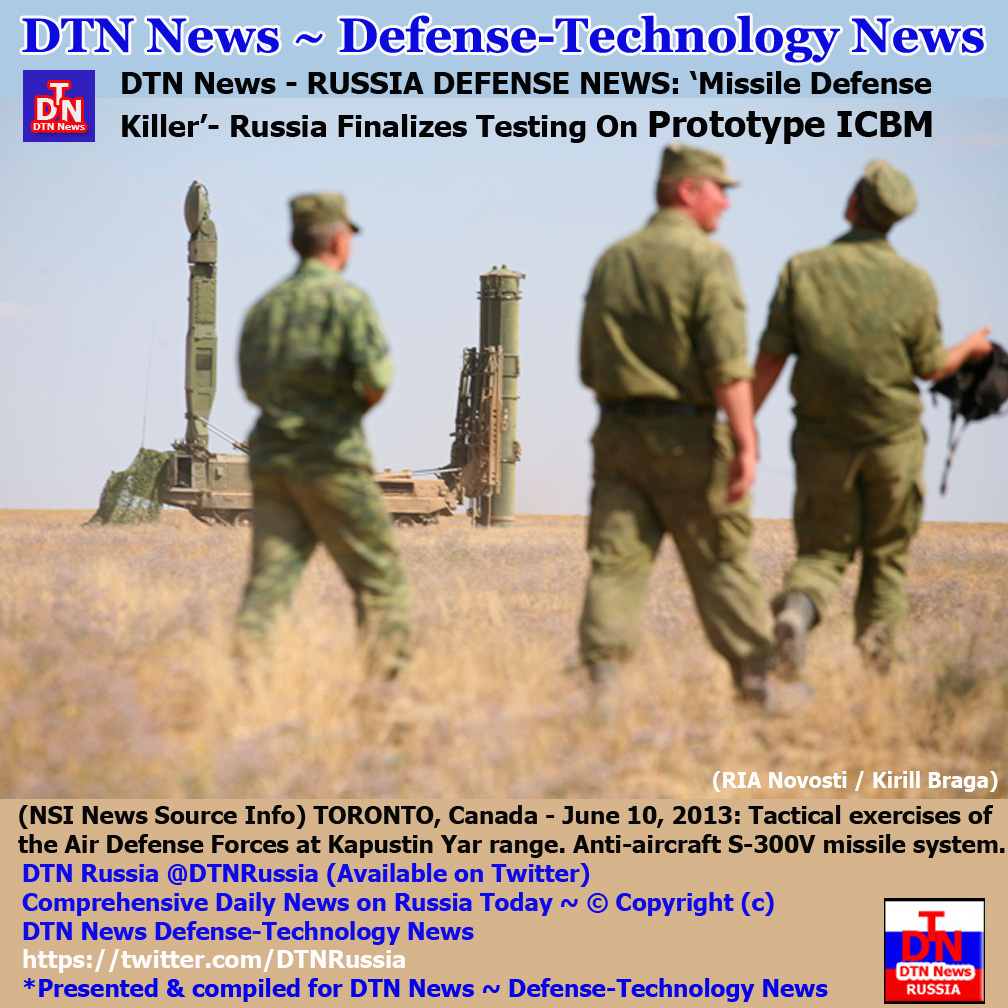
Tactical training exercises of Air Defense Forces at Kapustin Yar range. Troops prepare the anti-aircraft missile system S-300V to detect and destroy air targets. (RIA Novosti / Kirill Braga)

He also revealed that infrastructure preparations are underway for the new complex, as is personnel training and the coordination of combat crews.
"The new missile complex will have a significantly improved, compared with the existing complexes, maneuvering characteristics that significantly enhance the potential of Russia's nuclear forces to ensure strategic deterrence," Zarudnitsky concluded.
Russian Deputy Prime Minister Dmitry Rogozin welcomed the test, calling the new ICBM a “missile defense killer... Neither current nor future American missile defense systems will be able to prevent that missile from hitting a target dead on.”
Russian Deputy Prime Minister Dmitry Rogozin. (RIA Novosti / Sergey Mamontov)

Russia maintains at least 58 silo-based Soviet-made P36M ('SS-18 Satan' NATO classification) ballistic missiles, believed to be the most powerful in the world with up to 10 megaton-class warheads. The Strategic Missile Forces have 160 mobile Topol-M ('SS-25 Sickle') missile systems, 50 silo-based and 18 road-mobile Topol-M ('SS-27 Sickle B') systems, and 18 RS-24 Yars systems.
In recent years, two missile divisions were rearmed with the newest Topol-M and Yars systems, and more will follow in 2013. The Defense Ministry is also preparing to introduce the latest automated battle management system (ASBU), enabling rapid retargeting of ICBMs.
Russia sped up development of new intercontinental ballistic missile systems after the US announced plans to continue deploying its missile defense system in Eastern Europe, near Russian borders.
 
Tactical exercises of the Air Defense Forces at Kapustin Yar range. Anti-aircraft S-300V missile system. (RIA Novosti / Kirill Braga)

The issue of the US missile shield in Europe has become a major stumbling block in Russia-US relations. Moscow has demanded legal guarantees from Washington that missile defense systems deployed in Europe would not target Russia's strategic nuclear deterrence capabilities. But Washington refused, citing a need to protect Europe from ‘rogue states' like Iran and North Korea.
In mid-March of 2013, Washington attempted to engage Moscow in new talks about further nuclear arms reduction, after presidents Barack Obama and Dmitry Medvedev agreed to reduce their nuclear stocks with the New START arms reduction treaty. The US said it would no longer deploy SM-3 IIB ballistic missile interceptors in Poland until 2022.
Nevertheless, Moscow still demands legally binding guarantees from Washington that the system's intentions are peaceful.
On Monday, US Secretary of State John Kerry met with the Polish Foreign Minister, and committed to deploy missile defenses in Poland by 2018 as planned. “We are on track to deploy a missile defense site in Poland by 2018 as part of NATO’s modernized approach to our security,” Kerry said.
*Link for This article compiled by Roger Smith from reliable sources Russia Today
*Speaking Image - Creation of DTN News ~ Defense Technology News 
*Photograph: IPF (International Pool of Friends) + DTN News / otherwise source stated
*This article is being posted from Toronto, Canada By DTN News ~ Defense-Technology News Contact:dtnnews@ymail.com 
©COPYRIGHT (C) DTN NEWS DEFENSE-TECHNOLOGY NEWS

Thursday, March 1, 2012

DTN News - AIRLINES NEWS: Boeing, Air Astana Announce Order For Four 767-300ERs And Three 787 Dreamliners

Defense News: DTN News - AIRLINES NEWS: Boeing, Air Astana Announce Order For Four 767-300ERs And Three 787 Dreamliners
- Represents single largest order for commercial airplanes in Kazakhstan
Source: DTN News - - This article compiled by Roger Smith from reliable sources Boeing
(NSI News Source Info) TORONTO, Canada - March 1, 2012: Boeing (NYSE: BA) and Air Astana have announced an order for four 767-300ERs (Extended Range) and three 787-8s. The order is valued at $1.3 billion at current list prices, making this the largest single order for commercial airplanes in Kazakhstan's history.
"Our decision to order the Boeing airplanes is part of Air Astana's long-term growth strategy to expand and modernize our fleet with newer, more fuel-efficient airplanes to serve domestic, regional and international routes," said Peter Foster, president, Air Astana.  "In addition, we want to offer an enhanced travel experience for our customers which we shall be able to do on these airplanes."          
In addition to bringing big-jet ranges to mid-size airplanes, the 787 provides airlines with unmatched fuel efficiency using 20 percent less fuel than today's similarly sized airplanes. Passengers will also see improvements on the 787, from an interior environment with higher humidity to increased comfort and convenience.  
The Boeing 767 family is a complete family of clean, quiet, fuel-efficient airplanes that provide maximum market versatility in the 200- to 300-seat market. Boeing has delivered more than 1,000 767s that are flown by over 120 operators around the world.
"We are extremely pleased that Air Astana has partnered with Boeing to participate in the region's growing air transport market," said Marty Bentrott, vice president of sales for Middle East, Russia and Central Asia, Boeing Commercial Airplanes. "Today, airlines are increasingly looking at lower operating costs and fuel efficiency without compromising on technological innovations and customer experience. We are confident that both the 767-300ER and the 787 Dreamliner will play an important role as Air Astana continues with its expansion plans."
Contact:
Saffana Michael
Boeing Commercial Airplanes
+9 7150-4590651
Saffana.michael2@boeing.com
Photo and caption will be available here: http://boeing.mediaroom.com

 
*DTN Kazakhstan - - @DTNKazakhstan ~ Available on Twitter
Comprehensive Daily Related News on Kazakhstan Today ~ © Copyright (c) http://defense-technologynews.blogspot 

*Link for This article compiled by Roger Smith from reliable sources Boeing
*Speaking Image - Creation of DTN News ~ Defense Technology News 
*This article is being posted from Toronto, Canada By DTN News ~ Defense-Technology News Contact:dtnnews@ymail.com 
©COPYRIGHT (C) DTN NEWS DEFENSE-TECHNOLOGY NEWS 

Friday, December 30, 2011

DTN News - KAZAKHSTAN VIOLENCE: Kazakhstan Probes Police Use Of Weapons After Deaths

Defense News: DTN News - KAZAKHSTAN VIOLENCE: Kazakhstan Probes Police Use Of Weapons After Deaths

Source: DTN News - - This article compiled by Roger Smith from reliable sources BBC News
(NSI News Source Info) TORONTO, Canada - December 29, 2011: Prosecutors in Kazakhstan have opened a criminal inquiry into the use of weapons by police after 16 protesters were killed earlier this month.


The deaths occurred in clashes between police and oil protesting workers in Zhanaozen on 16 and 17 December.

A "criminal enquiry into the use of weapons by the security forces" had been opened, the prosecutor-general's office said on Thursday.


The violence was the worst since Kazakhstan's independence 20 years ago.

The investigation comes after video footage emerged on the internet appearing to show security forces beating and shooting people.

Eyewitnesses said police fired on unarmed oil workers, who had been protesting for months, in the town of 90,000.

But police say they were forced to defend themselves. A 20-day curfew is in effect until 5 January.

"General prosecutors opened a criminal enquiry into the use of weapons by the security forces which were aimed at hitting (their targets) and caused death," the prosecutors' spokesman Nurdaulet Suindikov said in a statement.

"An investigation group headed by a special prosecutor will carry out the investigation to ensure impartiality," the statement added.

The move marks the first time since the incident that Kazakh prosecutors have accused the police of firing on the protesters. Last week Kazakhstan asked the UN to help investigate the violence.

Separately, the privately-owned Interfax-Kazakhstan news agency reports that 18 people accused of taking part in the disturbances and looting have been arrested.

The governor of the Mangistau region, where the clashes occurred, has reportedly been sacked, along with the local boss of the state oil firm.

President Nursultan Nazarbayev has fired his son-in-law, Timur Kulibayev, from his position as head of Kazakhstan's sovereign wealth fund, which holds stakes in the companies whose workers were striking.

Correspondents say Mr Nazarbayev is keen to maintain his country's reputation as a bastion of stability in central Asia.
 
*Link for This article compiled by Roger Smith from reliable sources BBC News 
*Speaking Image - Creation of DTN News ~ Defense Technology News 
*This article is being posted from Toronto, Canada By DTN News ~ Defense-Technology News Contact:dtnnews@ymail.com 
©COPYRIGHT (C) DTN NEWS DEFENSE-TECHNOLOGY NEWS

Thursday, November 11, 2010

DTN News: Kazakhstan Seeks Defence Deal For 45 EC145s

Defense News: DTN News: Kazakhstan Seeks Defence Deal For 45 EC145s
Source: DTN News - - This article compiled by Roger Smith from reliable sources By Craig Hoyle - Flight International
(NSI News Source Info) HONG KONG - November 11, 2010: Kazakhstan could acquire up to 45 Eurocopter EC145 medium-twin helicopters for military applications, under a new memorandum of understanding signed with the European company, its parent EADS and the nation's defence ministry.

Eurocopter says the nation should take delivery of the new aircraft within a six-year period under the proposed deal, which was signed by Kazakh president Nursultan Abishuly Nazarbayev during his visit to France in late October.

A related agreement calls for the establishment of a new joint venture with local company Kazakhstan Engineering, which will complete the newly designated KH145s in Astana. It should deliver the first batch of six aircraft in late 2011, Eurocopter says, with the co-production pact expected to become operational next month. "The agreement also includes the development of local maintenance and training activities," the company adds.

Eurocopter chief executive Lutz Bertling says the arrangement will create "several hundreds of highly qualified jobs" and also "foster helicopter usage in Kazakhstan". He also believes the new joint venture will be able to compete for additional business in Belarus, Russia and central Asia, with other applications including parapublic operations and supporting the oil and gas sector.

Sales of the EC145 have now topped 400 aircraft, Eurocopter says. This includes the UH-72A Lakota variant being delivered to the US Army by American Eurocopter under the service's light utility helicopter programme. The company has so far handed over its 114 of the aircraft, says Flightglobal's HeliCAS database.

Kazakhstan Engineering also recently signed a memorandum of co-operation with France's Sagem on a proposed joint venture to produce, sell and market tactical unmanned air vehicles.


*This article is being posted from Toronto, Canada By DTN News ~ Defense-Technology News, contact: dtnnews@ymail.com
© Copyright (c) DTN News Defense-Technology News

Saturday, October 23, 2010

DTN News: Russian, Kazakh Pilots To Hone Live-Firing Skills Prior To CSTO Drills

Defense News: DTN News: Russian, Kazakh Pilots To Hone Live-Firing Skills Prior To CSTO Drills
Source: DTN News / Ria Novosti
(NSI News Source Info) MOSCOW, Russia - October 23, 2010: Russian and Kazakh combat pilots will take part on Friday in live-firing exercises in preparation for the upcoming large-scale exercises of the Collective Security Treaty Organization (CSTO), the Russian Defense Ministry said.

The CSTO Collective Rapid Reaction Force drills will take place on October 25-29 at the Chebarkul training ground in Russia's Urals region of Chelyabinsk.

"On October 22, pilots of the Russian Su-24 and Su-27 aircraft and Mi-24 helicopters together with Kazakh Su-25 pilots will conduct drills with live firing at the Chebarkul training grounds in the Central military district," a spokesman for the ministry said on Thursday.

The upcoming CSTO drills will involve 1,700 servicemen, 250 armored vehicles and over 30 combat aircraft and helicopters.

The CSTO is a security grouping comprising the former Soviet republics of Armenia, Belarus, Kazakhstan, Kyrgyzstan, Russia, Uzbekistan, and Tajikistan.

Five of the seven members signed an agreement on the creation of the Collective Rapid Reaction Force in February 2009. Belarus, which initially refrained from signing the deal because of a trade dispute with Russia, joined later last year.

The CSTO members say the rapid reaction force is designed to improve the security of the CSTO members against existing and potential threats, including terrorism, extremism, drug trafficking and natural disasters, and to enhance the organization's role in ensuring international security.

However, many observers see the creation of a powerful military contingent in former Soviet Central Asia by members of the Russian-dominated security grouping as a bid to counterbalance NATO.

*THIS ARTICLE IS BEING POSTED FROM TORONTO, CANADA BY DTN NEWS ~ DEFENSE-TECHNOLOGY NEWS, CONTACT:DTNNEWS@YMAIL.COM

Saturday, June 13, 2009

Russia to make WTO bid jointly with Belarus and Kazakhstan

MOSCOW. (RIA Novosti economic commentator Oleg Mityayev) – After 16 years of touch-and-go accession talks with the WTO, the Russian authorities have decided to stop the process of individual accession and make a joint bid with Belarus and Kazakhstan instead.
The decision was announced at a meeting of their Customs Union on June 9.
Later that day, the meeting of the Eurasian Economic Community established Eurasec’s Anti-crisis Fund to the amount of $10 billion.
Russian Prime Minister Vladimir Putin said on June 9 after a meeting of the Customs Union’s Supreme Body that Russia would no longer have to negotiate accession to the World Trade Organization as an independent state.
“WTO accession remains a joint priority for us,” he said. Russia, Belarus and Kazakhstan are still seeking WTO entry, “but as a united customs union, not as separate countries.”
However, they first need to formalize their union, which is to become operational on January 1, 2010, when its common customs tariff will be applied.
Russia’s First Deputy Prime Minister Igor Shuvalov said the tariff had been fully coordinated, with a transition period established for sensitive groups of goods during which the three countries will apply their own tariffs for such goods.
By July 1, 2011, customs control will be moved to the three countries’ common border and the customs borders between them will be liquidated.
The possibility of a joint bid by several countries is stipulated in the WTO procedure. However, Russia has covered 95% of the road as an independent state. Since 1993, it has coordinated with the WTO member states the most complicated terms and conditions for its entry, such as the mechanism of foreign banks’ access to the Russian banking system.
However, President Dmitry Medvedev said the accession process was taking too long and looked more like insincere promises than a genuine desire to admit Russia in the past few years.
Moscow has likely come to see that some Western countries are using the WTO accession talks for political bargaining.
Moreover, accession benefits are questionable especially since the global energy markets are already open to Russia’s main export commodity – energy. Metallurgy is one of the few Russian industries that may benefit from WTO accession, while other sectors will most likely lose. Besides, a crisis is not the best time for opening one’s market.
Russia’s intention to bid for WTO accession jointly with Belarus and Kazakhstan will put off accession for years. But Moscow has apparently decided that strengthening economic ties with its closest neighbors is more important than the WTO entry.
On June 9, Moscow also hosted a meeting of Eurasec’s Interstate Council.
Eurasec comprises Belarus, Kazakhstan, Kyrgyzstan, Russia and Tajikistan, while Moldova, Ukraine and Armenia have observer status.
It was announced after the meeting that Eurasec and Armenia had set up an Anti-crisis Fund to the amount of $10 billion. Since Russia will contribute $7.5 billion, its finance minister, Alexei Kudrin, was elected chairman of the fund.
The money will be used to issue sovereign loans to the member states and finance interstate investment projects.
The Fund will become a regional analogue of the International Monetary Fund (IMF), which issues stabilization loans, and the European Bank for Reconstruction and Development (EBRD), which finances investment projects.
Russia has recently refused to increase its IMF fees, which are used to issue stabilization loans to countries worldwide. It is now using the money to set up a regional fund for assistance to its allies.