Tuesday, May 25, 2010

DTN News: U.S. Department of Defense Contracts Dated May 25, 2010

Defense News: DTN News: U.S. Department of Defense Contracts Dated May 25, 2010
Source: U.S. DoD issued May 25, 2010
(NSI News Source Info) WASHINGTON - May 26, 2010: U.S. Department of Defense, Office of the Assistant Secretary of Defense (Public Affairs) Contracts issued May 25, 2010 are undermentioned;<>
CONTRACTS
ARMY

~Raytheon Co., Marlborough, Mass., was awarded on May 21 a $92,472,706 firm-fixed-price contract for AN/TSC-154A advanced extremely high frequency Secure Mobile Anti-jam Reliable Tactical Terminals. Work is to be performed in Marlborough, Mass., with an estimated completion date of March 21, 2018. One sole-source bid was solicited with one bid received. CECOM Acquisition Center, Fort Monmouth, N.J., is the contracting activity (W15P7T-07-D-L405).
~IAP Worldwide Services, Panama City, Fla., was awarded on May 21 a $45,335,621 firm-fixed-price contract for line haul transportation within Kuwait and Iraq. Work is to be performed in Kuwait (50 percent) and Iraq (50 percent), with an estimated completion date of Dec. 31, 2010. One bid was solicited with one bid received. U.S. Army Contracting Command, Rock Island Contracting Center, ACC-RICC-CCRC-RK, Rock Island, Ill., is the contracting activity (W912D1-05-D-0011).
~Amatea/Grimberg, JV, Leesburg, Va., was awarded on May 21 an $11,307,782 firm-fixed-price contract. This contract is for the construction of a Command and Control Integration Facility single-story building containing warehouse storage, loading docks, offices, software loading, integration labs and support space. The building includes an electromagnetic antenna testing chamber totaling approximately 75,930 gross square feet. Work is to be performed in Aberdeen, Md., with an estimated completion date of June 15, 2011. Ninety-three bids were solicited with six bids received. U.S. Army Corps of Engineers, Philadelphia, Pa., is the contracting activity (W912BU-10-C-0023).
~Kipper Tool Co., Gainesville, Ga., was awarded on May 21 a $10,039,608 firm-fixed-price contract, a current contracts and delivery order for an additional 48 standard automotive tool sets. Work is to be performed in Gainesville, Ga., with an estimated completion date of June 30, 2011. One bid was solicited with one bid received. TACOM Contracting Command, Rock Island Arsenal, Ill., is the contracting activity (DAAE-20-03-D-0085).
~Monarch Construction Co., Cincinnati, Ohio, was awarded on May 21 an $8,167,000 firm-fixed-price contract for the construction of Walnut Street fountain and grand stairway, Ohio Riverfront, Cincinnati, Ohio. Work is to be performed in Cincinnati, Ohio, with an estimated completion date of July 31, 2011. Bids were solicited on the World Wide Web with eight bids received. U.S. Corps of Engineers, Louisville District, Louisville, Ky., is the contracting activity (W912QR-10-C-0056).
~Sota Construction Services, Inc., Pittsburgh, Pa., was awarded on May 21 an $8,128,000 construction firm-fixed-price contract for the construction of a reserve lodging facility. Work is to be performed in Pittsburgh, Pa., with an estimated completion date of Nov. 30, 2011. Bids were solicited via the Federal Business Opportunities Web site with three bids received. U.S. Army Corps of Engineers, Louisville District Office, CELRLCT-M, Louisville, Ky., is the contracting activity (W912QR-10-C-0057).
~McConnell Dowell, Ltd, Pago Pago, American Samoa, was awarded on May 20 a $6,646,892 firm-fixed-price contract for road pavement and shore protection construction contract entitled “PN ER-AQ-ER4-1 (016) Cyclone Heta Repair and ER-AQ-ERS5-1(2) Cyclone Olaf Repair of Route 030, Tau Road Island.” Work is to be performed on the island of Tau in American Samoa., with an estimated completion date of Nov. 21, 2011. Bids were solicited via unrestricted procurement with two bids received. U.S. Army Corps of Engineers, Honolulu District, Fort Shafter, Hawaii, is the contracting activity (W9128A-10-C-0006).
NAVY
~Northrop Grumman Systems Corp., Bethpage, N.Y.,
is being awarded a $71,028,648 modification to a previously awarded cost-plus-award-fee/cost-plus-incentive-fee contract (N00019-03-C-0057) to provide operational evaluation readiness preparation services in support of the E-2D Advanced Hawkeye System Development and Demonstration (SD&D) program. Services to be provided include flight test support, integrated logistics support, supply support, and depot capabilities support for two SD&D aircraft and three pilot production aircraft. Work will be performed in Bethpage, N.Y. (81 percent); Syracuse, N.Y. (7 percent); Indianapolis, Ind. (3 percent); San Francisco, Calif. (1 percent); Greenlawn, N.Y. (1 percent); West Chester, Ohio (1 percent); Falls Church, Va. (1 percent); Ronkonkoma, N.Y. (1 percent); Owego, N.Y. (1 percent); Marlboro, Mass. (1 percent); Wyndmoor, Pa. (1 percent), and Rome, Italy (1 percent). Work is expected to be completed in September 2012. Contract funds will not expire at the end of the current fiscal year. The Naval Air Systems Command, Patuxent River, Md., is the contracting activity.
~BAE Systems, Land & Armaments L.P., U.S. Combat Systems, Minneapolis, Minn., is being awarded a $23,007,956 firm-fixed-price contract modification to previously awarded contract (N00024-09-C-5317) for the fiscal 2009 canister production requirements for MK13, MK14, MK-21 and MK25 canisters to support integration of the Evolved Sea Sparrow, Tomahawk cruise, and Standard missiles into the MK 41 Vertical Launching System (VLS). The MK 41 VLS provides a missile launching system for CG 47- and DDG 51-class surface combatants of the U.S. Navy, as well as surface combatants of allied navies. Work will be performed in Aberdeen, S.D. (78 percent), Odessa, Mo. (12 percent), and Minneapolis, Minn. (10 percent), and is expected to be completed by February 2012. Contract funds will not expire at the end of the current fiscal year. The Naval Sea Systems Command, Washington Navy Yard, D.C., is the contracting activity.
~L-3 Communications, California Tube Laboratory, Watsonville, Calif., is being awarded a $10,470,281 firm-fixed-price and time and material indefinite-delivery/indefinite-quantity contract for the procurement of 275 magnetrons, including engineering, technical and repair support services. The magnetrons are installed in airborne pods for use on manned aircraft used to evaluate U.S. weapons systems and to train fleet operators. Work will be performed in Watsonville, Calif., and is expected to be completed in May 2015. Contract funds will not expire at the end of the current fiscal year. This contract was competitively procured via an electronic request for proposals with two proposals received. The Naval Air Warfare Center Weapons Division, China Lake, Calif., is the contracting activity (N68936-10-D-0038).
~CPI, Inc., Beverly, Mass., is being awarded a $9,578,221 firm-fixed-price and time-and-material indefinite-delivery/indefinite-quantity contract for the procurement of 450 magnetrons, including engineering, technical and repair support services. The magnetrons are installed in airborne pods for use on manned aircraft used to evaluate U.S. weapons systems and to train fleet operators. Work will be performed in Beverly, Mass., and is expected to be completed in May 2015. Contract funds will not expire at the end of the current fiscal year. This contract was competitively procured via an electronic request for proposals with two proposals received. The Naval Air Warfare Center Weapons Division, China Lake, Calif., is the contracting activity (N68936-10-D-0039).
~Raytheon Technical Services Co., LLC, Norfolk, Va., is being awarded a $6,800,000 firm-fixed-price contract for engineering services and supplies to overhaul, repair and upgrade the MK 57 NATO Sea Sparrow surface missile system (NSSMS). This procurement is to provide all necessary materials and services to overhaul, repair, perform pierside maintenance, modify and/or update components or parts of the MK57 NSSMS. This effort includes the inspection of equipment; installation/deinstallation; repair; performance of all testing in accordance with the latest quality assurance program specifications; associated training; packaging/packing/marking; program reporting/liaison/coordination with industry/government; and storage pending final destination disposition instructions. Work will be performed in Norfolk, Va., and is expected to be completed by October 2011. Contract funds will not expire at the end of the fiscal year. This order was not competitively procured. The Port Hueneme Division, Naval Surface Warfare Center, Port Hueneme, Calif., is the contracting activity (N00024-09-G-5422).
DEFENSE LOGISTICS AGENCY
~Produce Source Partners*, Newport News, Va., is being awarded a maximum $13,800,000 fixed-price with economic price adjustment, total set-aside contract for full-line fresh fruit and vegetable support. Other location of performance is Norfolk, Va. Using services are Army, Navy and Marine Corps. The original proposal was Web solicited with three responses. This contract is exercising the second option-year period. The date of performance completion is Nov. 29 2011. The Defense Supply Center Philadelphia, Philadelphia, Pa., is the contracting activity (SPM300-08-D-P001).
AIR FORCE
~Booz Allen Hamilton, Inc., Herndon, Va., was awarded a $7,996,064 contract which will provide systems engineering warfare/radio frequency survivability and vulnerability analysis. At this time, $267,857 has been obligated. 55 CONS/LGCD, Offutt Air Force Base, Neb., is the contracting activity (SP0700-03-D-1380).
~ITT Corp., Systems Division, Patrick Air Force Base, Fla., was awarded a $6,950,284 contract which will provide integration services to support the launch and range systems contract to install additional hardware to an existing string of telemetry equipment at the Oak Mountain A site at the western range in Vandenberg, Calif. The entire amount has been obligated. SMC/LRSW/PK, Los Angeles Air Force Base, Calif., is the contracting activity (F04701-01-C-0001).

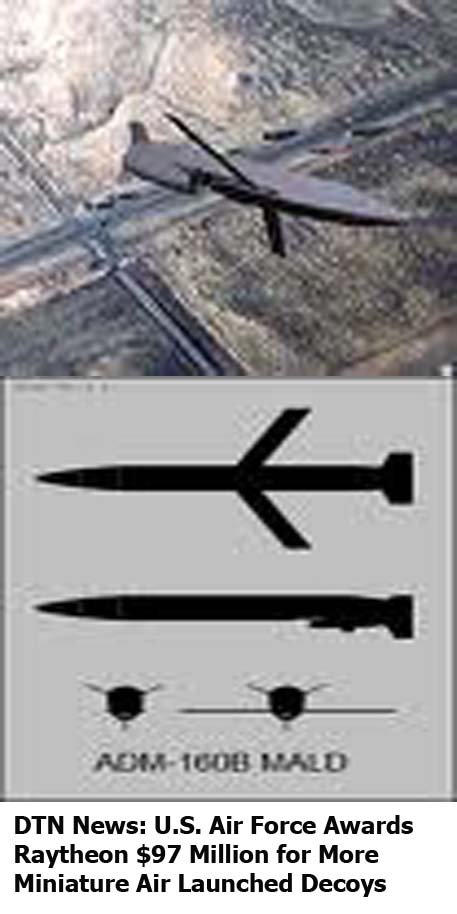
DTN News: U.S. Air Force Awards Raytheon $97 Million For More Miniature Air Launched Decoys

Defense News: DTN News: U.S. Air Force Awards Raytheon $97 Million For More Miniature Air Launched Decoys
Source: DTN News / Raytheon
(NSI News Source Info) TUCSON, Ariz., - May 26, 2010: The U.S. Air Force awarded Raytheon Company (NYSE: RTN) $96.7 million for a third production lot of the Miniature Air Launched Decoy.
MALD™ is a state-of-the-art, low-cost, decoy flight vehicle that is modular, air-launched and programmable. It weighs less than 300 pounds and has a range of approximately 500 nautical miles (about 575 statute miles).
"MALD protects aircrew and their aircraft by mimicking the signatures and combat flight profiles of U.S. and allied aircraft," said Ken Watson, the U.S. Air Force's MALD program manager. "This contract delivers additional capabilities to the combatant commanders by giving them more options to shape the battlespace."
MALD is currently in production, and Raytheon has delivered more than 100 units to the U.S. Air Force. This new contract calls for the company to build approximately 300 additional decoys -- nearly equal to the total of Lots I and II combined. Additionally, the contract requires the delivery of the MALD-Jammer in preparation for the MALD-J™ initial operational test and evaluation phase, with production expected to begin in 2011.
"This contract showcases the reliability and capability of the baseline program," said Scott Muse, Raytheon's MALD program director. "MALD can be certified on any aircraft with a 14-inch suspension carriage, and its modular design opens the door to numerous options beyond the stand-in-jammer, making MALD an ideal solution for the men and women in uniform."
Raytheon Company, with 2009 sales of $25 billion, is a technology and innovation leader specializing in defense, homeland security and other government markets throughout the world. With a history of innovation spanning 88 years, Raytheon provides state-of-the-art electronics, mission systems integration and other capabilities in the areas of sensing; effects; and command, control, communications and intelligence systems, as well as a broad range of mission support services. With headquarters in Waltham, Mass., Raytheon employs 75,000 people worldwide.
Note to Editors:
More than 125 Raytheon employees design and build the MALD and MALD-J in Tucson, Ariz.; Goleta, Calif.; and El Segundo, Calif.
Hundreds of employees in scores of businesses across the U.S. design and manufacture MALD and MALD-J components. Major suppliers include: AML Communications, Camarillo, Calif.; AUSCO, Port Washington, N.Y.; BAE, Berthoud, Colo.; CEI, Sacramento, Calif.; Celestica, Austin, Texas; Eagle Pitcher, Joplin, Mo.; EDO, Bohemia, N.Y.; Enser, Pinellas Park, Fla.; Engineered Fabrics Corp, Rockmart, Ga.; GDOTS, Redmond, Wash.; Hamilton-Sundstrand, Rockford, Ill.; Hamilton-Sundstrand, San Diego; LaBarge, Joplin, Mo.; Moog, East Aurora, N.Y.; Tecom, Westlake Village, Calif.
http://www.raytheon.com/
Contact:
Mike Nachshen
520.794.4088 (office)
520.269.5697 (mobile)
michael_nachshen@raytheon.com

DTN News: Boeing 787 Dreamliner Arrives In Arizona

Defense News: DTN News: Boeing 787 Dreamliner Arrives In Arizona
Source: DTN News / Boeing
(NSI News Source Info) MESA, Ariz., - May 26, 2010: The Boeing [NYSE:BA] 787 Dreamliner made its first landing at Phoenix-Mesa Gateway Airport this weekend. The fourth 787 to be built, ZA004, is undergoing a short series of tests that require a combination of hot weather and low-altitude conditions. A crew of nearly 75 is supporting the airplane to ensure smooth operations during testing. The stay in Arizona is expected to last only a few days.
The 787 flight test fleet, currently comprised of four airplanes, has logged more than 820 hours of flying in the last six months. Two more airplanes are expected to join the flight test fleet soon.
*Final Boeing 747 Dreamlifter Enters Service ~ The fourth Boeing (NYSE: BA) Dreamlifter – the final airplane in the fleet of specially modified 747-400s – entered service today.
Dreamlifters transport the large composite structures of the 787 Dreamliner from partners around the world to Everett, Wash. for final assembly. The unique airplane, which was modified by Evergreen Aviation Technologies Corp. in Taipei, Taiwan, took off from Paine Field in Everett early this morning. Bound for Wichita, Kan., the Dreamlifter is returning the equipment used to transport the forward fuselage section known as section 41. The airplane's registry is N718BA.
Contact:
Lori Gunter
787 Communications
+1 206-9312-5919

DTN News: Stocks Drop After Euro Slumps, Dow Falls Below 10K / Europe's Markets Suffer New Falls On Debt Worries

Defense News: DTN News: Stocks Drop After Euro Slumps, Dow Falls Below 10K / Europe's Markets Suffer New Falls On Debt Worries
*Stocks tumble on worries about debt in Europe, tensions on Korean peninsula; Dow below 10K
Source: DTN News / AP Stephen Bernard and Tim Paradis, AP Business Writers,
(NSI News Source Info) NEW YORK - May 25, 2010: The Dow Jones industrialsplunged below 10,000 Tuesday after traders dumped stocks on expectations that the world economy will weaken in the coming months.
The Dow fell about 190 points in afternoon trading. It has fallen about 1,330 points, or nearly 12 percent, from its recent high of 11,205, reached April 26. The Dow and broader stock indexes all fell more than 1 percent.
Investors also exited the euro and commodities including oil and again sought safety in Treasurys. That drove interest rates lower. The benchmark 10-year note's yield fell to its lowest level since April 2009.
Investors were anxious about problems beyond the financial crisis in Europe. Tensions between North and South Korea reminded traders that political issues can be a threat to economic growth. And analysts said that even the still unresolved oil spill in the Gulf of Mexico contributed to investors' foul mood.
Still, uncertainty over the impact that Europe's debt problems could have on the rest of the world in the coming months remains the biggest driver of investor pessimism, said Jonathan Corpina, president of Meridian Equity Partners. The largest concern is that painful austerity measures that European governments are being forced to take could lead to a prolonged economic slump in the region and cause another global recession. And investors fear that even those measures won't contain the crisis, Corpina said.
"It seems like the Europeans are playing 'tag, you're it ' -- first it was Greece and now it's maybe Spain or Portugal," said Corpina, a New York Stock Exchange floor trader. "We know someone else is next. The problem is that it seems like every plan in place isn't going to satisfy the needs." A warning of hard times came from Britain's Queen Elizabeth, who opened the new session of Parliament with a speech delivered on behalf of Britain's new coalition government. The queen, said there would be budget cuts because "the first priority is to reduce the deficit and restore economic growth."
Other European countries are imposing budget cuts as well, trying to control their debts. Investors are concerned that these steps will stifle economic growth, and that other countries including the U.S. will inevitably see their own growth stunted.
European Union leaders warned Tuesday that the continent's economy would stagnate unless governments make major reforms to promote growth. The problem is, though, that large debts in some countries make it difficult to implement stimulus measures to rally economies.
Traders have been selling the euro heavily in recent weeks because of uneasiness over whether steep budget cuts in countries like Greece, Spain and Portugal will drag down an economic recovery on the continent. Italy was set to become the latest European nation to announce spending cuts to reduce its deficit.
The euro approached a four-year low, which it set last week. The euro dropped to $1.2285, close to the low of $1.2146 it touched last week.
Investors are not focusing on current signs of growth, but are instead trying to gauge where the global economy will be later this year. Pessimism, particularly about Europe, has replaced a hopeful tone among traders early in the year.
"Market participants feel like they're walking on eggshells," said Oliver Pursche, executive vice president at Gary Goldberg Financial Services in Suffern, N.Y. "Every small piece of potentially bad news is being exaggerated and mentally being fast-forwarded to the worst-case scenario."
Markets were also hurt by reports that North Korean leader Kim Jong Il ordered his military to combat alert because of rising tensions on the Korean peninsula. North Korea also said it would cease communication and relations with Seoul. South Korea has said North Korea was responsible for the sinking of a South Korean warship two months ago. Major indexes in Japan and Hong Kong fell more than 3 percent.
Meanwhile, the monthlong effort to cap the Gulf oil well that has spewed millions of gallons of oil is also rattling investors, Corpina said. Oil is now starting to come ashore across a 150-mile swath of the Gulf Coast, endangering wildlife and livelihoods in commercial fishing and tourism.
"The worry is that the situation is getting worse and there's no real fix," he said. "First we were just talking about the oil industry being affected. Now it's the environment and fishing industries. Next we'll be talking about the hotel and leisure industries."
A disappointing report on U.S. home prices added to the downcast mood. The Standard & Poor's/Case-Shiller 20-city home price index fell 0.5 percent in March from February, a sign that the housing market remains weak even as mortgage rates are still near historic lows.
A better-than-expected report on consumer confidence didn't stop the selling. The Conference Board's consumer confidence index rose for the third straight month, climbing to 63.3 in May from 57.7 last month.
The Dow fell 190.07, or 1.9 percent, to 9,876.50 by early afternoon. Only one of the 30 Dow stocks, Home Depot Inc., rose, and that was just by pennies.
The Standard & Poor's 500 index fell 20.13, or 1.9 percent, to 1,053.52. The index hit its lowest level of the year in early trading, dropping to 1,040.78.
The Nasdaq composite index fell 42.75, or 1.9 percent, to 2,170.80.
The yield on the benchmark 10-year Treasury note, which moves opposite its price, fell to 3.14 percent from 3.20 percent late Monday. It fell as low as 3.07 percent, its lowest level since April 2009.
The yield on the 30-year bond briefly fell below 4 percent for the first time since October, before rising slightly. It is down to 4.04 percent from 4.08 percent late Monday.
Crude oil fell $2.16 to $68.05 a barrel on the New York Mercantile Exchange, in part a reflection of expectations that weak economic growth will curtail demand for fuel.
Top Stories
*
Stocks Sink Amid Global Economy Woes; Dow Below 10,000 - AP
*
Bullard: Europe's woes unlikely to spur recession - AP
*
Oil sinks as stock markets, euro fall - AP
*
Falling home prices raise fears of new bottom - AP

DTN News: US Admiral Critiques Military Ties With China

Defense News: DTN News: US Admiral Critiques Military Ties With China
Source: DTN News / AP
(NSI News Source Info) BEIJING, China - May 25, 2010: The commander of U.S. forces in the Pacific said Tuesday that military ties with China are lagging behind the two countries' other dealings in maturity and sophistication.
Admiral Robert Willard told People's Liberation Army deputy chief of staff, Lt. Gen. Ma Xiaotian, that it was regretful that military ties were so far behind the "other very mature engagements that occur between our two countries."
Willard made the comment during the first high-level military talks between the sides since Beijing suspended military exchanges earlier this year in anger over U.S. arms sales to Taiwan, the self-governing island China claims as its own territory.
Ma voiced his own frustration, saying Chinese plans for military exchanges with the United States in 2010 had been "seriously disrupted" by the Obama administration's announcement in January. Washington said Jan. 30 that it would go ahead with a sale of $6.4 billion in military hardware to Taiwan — including helicopters, missiles and other weapons.
Willard is in Beijing as part of a second round of strategic talks, termed the Strategic and Economic Dialogue, that began last year in Washington. The gathering brings together dozens of Cabinet officials from both sides, the chiefs of both central banks and military officers.
"It has been a great pleasure to attend the Strategic Economic Dialogue. I've been struck by the maturity and sophistication in the level of exchange between the United States in China in a wide variety of areas," Willard told Ma. "Regretfully, the military to military relationship, we think, lags far behind these other very mature engagements that occur between our two countries."
Reporters were ushered out of the room shortly after Willard's comments and the U.S. Embassy in Beijing was not immediately able to confirm what else was discussed.
China and Taiwan split amid civil war in 1949. Beijing continues to claim the island as part of its territory and has threatened to invade if Taiwan moves to make its de facto independence permanent.

DTN News: Lockheed Martin Delivers First U.S. Air Force Advanced EHF Satellite

Defense News: DTN News: Lockheed Martin Delivers First U.S. Air Force Advanced EHF Satellite
*New-Generation Protected Military Communications Satellite Scheduled to Launch July 2010
Source: DTN News / Lockheed Martin
(NSI News Source Info) SUNNYVALE, Calif., - May 25, 2010: Lockheed Martin [NYSE: LMT] has delivered the first satellite in the Advanced Extremely High Frequency (AEHF) program to Cape Canaveral Air Force Station, Fla., where it will be prepared for a July 30 liftoff aboard an Atlas V launch vehicle. The AEHF system will provide the U.S. military and national leaders with global, protected, high capacity and secure communications.
“Shipment of the first AEHF satellite is testimony to a strong government and industry partnership focused on achieving total mission success on this vitally important program,” said Col. Michael Sarchet, commander of the Protected Satellite Communications Group at the U.S. Air Force’s Space and Missile Systems Center. “AEHF will play an integral role in our national security space architecture, and we look forward to providing this new capability to the warfighter.”
The AEHF system is the successor to the five-satellite Milstar constellation and will provide significantly improved global, highly secure, protected, survivable communications for all warfighters serving U.S. national security. The governments of Canada, The Netherlands, and the United Kingdom participate in the AEHF program as international partners and will have access to the communications capability of AEHF.
A single AEHF satellite will provide greater total capacity than the entire Milstar constellation currently on-orbit. Individual user data rates can be up to five times higher than Milstar’s highest speed. The faster data rates will permit transmission of tactical military communications, such as high-quality real-time video and quick access to battlefield maps and targeting data.
“Lockheed Martin is extremely proud of this significant program milestone,” said Mike Davis, Lockheed Martin’s AEHF vice president. “This satellite will provide substantially improved protected communications capabilities for the warfighter, and we look forward to achieving mission success for our customer.”
The second AEHF spacecraft (SV-2) has completed Final Integrated System Test which verified all spacecraft interfaces, demonstrated full functionality and evaluated satellite performance and is now preparing for Intersegment testing to ensure the spacecraft is ready for flight. The third AEHF satellite, SV-3, has completed acoustic testing, one of several critical environmental tests that validate the overall satellite design, quality of workmanship and survivability during space vehicle launching and on-orbit operations. SV-2 and SV-3 are on track for launch readiness in 2011.
The AEHF team is led by the U.S. Air Force Military Satellite Communications Systems Wing at the Space and Missile Systems Center, Los Angeles Air Force Base, Calif. Lockheed Martin Space Systems Company, Sunnyvale, Calif., is the AEHF prime contractor and system manager, with Northrop Grumman Aerospace Systems, Redondo Beach, Calif., as the payload provider.
“Assured communications for our military services is absolutely essential wherever they may be deployed,” said Stuart Linsky, vice president, Satellite Communications, for Northrop Grumman. “Capabilities provided by AEHF will give more warfighters access to the protected communications they need.”
Lockheed Martin is currently under contract to provide three AEHF satellites and the Mission Control Segment. The program has begun advanced procurement of long-lead components for a fourth AEHF satellite.
Headquartered in Bethesda, Md., Lockheed Martin is a global security company that employs about 136,000 people worldwide and is principally engaged in the research, design, development, manufacture, integration and sustainment of advanced technology systems, products and services. The Corporation reported 2009 sales of $45.2 billion.
Media Contacts:
Lauren Wonder, 408-756-4225; e-mail, lauren.e.wonder@lmco.com
NOTE TO EDITORS:
for low- and high-resolution JPEG image files of Advanced EHF, please visit: http://www.lockheedmartin.com/AEHF

DTN News: Pakistan TODAY May 25, 2010 ~ Military Operations In North Waziristan

Defense News: DTN News: Pakistan TODAY May 25, 2010 ~ Military Operations In North Waziristan
Source: PakObserver By M Ashraf Mirza
(NSI News Source Info) ISLAMABAD, Pakistan - May 25, 2010: Pakistan has ultimately agreed to launch military operations in North Waziristan, but has said that it alone will decide its timings. ‘Discussions focused on measures that both the countries (the US and Pakistan) are and will be taking to confront the common threat we face from extremists and prevent such potential attacks from occurring again…both sides pledged to do everything possible to protect our citizens’, said a joint statement issued after recent meetings of the US National Security Advisor Gen James Jones and CIA chief Leon Panetta with President Zardari, Prime Minister Gilani and Chief of Army Staff, Gen Pervez Kayani in Islamabad.
After prolonged reluctance, Pakistan has seemingly succumbed to the US pressure amidst reports that the US officials have conveyed President Obama’s ‘a blunt message’ to Pakistan’s political and military leadership about Times’ Square bombing conspiracy alleged to have been hatched in North Waziristan. Secretary of State Hillary Clinton had, in fact, threatened that any future attack on the US soil will have ‘serious consequences’ for Pakistan.
Pakistan’s civil and military leaders reportedly told the US officials that the Pak army is not in a position to move immediately into North Waziristan because of a number of factors including efforts to consolidate the gains made in the areas cleared of Taliban and capacity as well as resource issues. A meeting of the Troika viz President, Prime Minister and COAS later also decided that the operations will be carried out solely on the prerogative and discretion of Pakistan. Foreign Office says that the operation will be launched in keeping with the country’s plans and priorities and not at Washington’s behest. ‘It will be our sovereign decision as to when and how to proceed’, Foreign Office spokesman Abdul Basit told journalists at his weekly briefing. Interestingly, Defence Secretary Robert Gates and Admiral Mike Mullen have also said that the US is not pushing Pakistan to launch a military offensive in North Waziristan. US officials’ meeting with Pakistan’s civil and military leadership had focused on the overall strategy for combating terrorism and not on any particular operation, they said.
The fact of the matter is that the United States has been exerting pressure on Pakistan to send its troops into North Waziristan after Pak Army’s successful military action in Swat and South Waziristan. Pak Army’s success was undoubtedly glorious and enviable despite the loss of life. US and NATO forces have no such achievement to their credit in Afghanistan since its occupation about a decade ago. Washington, therefore, wants to push Pakistan into North Waziristan to destroy the militants’ safe heaven like it did in Swat and South Waziristan. It wishes to see the militants engaged by Pakistan so as to relieve pressure on the NATO forces in Afghanistan. Pakistan’s leadership has, however, been in a state of doldrums on the issue as it’s mindful that it may prove as hornet’s nest not only for Pakistan but also for the region as a whole since it has become hotbed of local and foreign militants after having been pushed out of Swat and South Waziristan as well as from Kandhar and other areas of Afghanistan.
There is no doubt that North Waziristan has become militants’ powerful sanctuary with thousands of militants believed to have taken refuge in the area. Pakistan has defeated the militants in Swat and South Waziristan as a result of the carefully planned and executed operations carried out in the suitable environment. It cannot obviously afford to plunge into North Waziristan without proper planning and preparation.
There are, however, many a pitfall tagged to the military operation in North Waziristan. Pakistan has friendly militant leaders like Jalaluddin Haqqani and Sirajuddin Haqqani in North Waziristan, who are fighting to compel the United States vacate its aggression in Afghanistan, but have seldom created any problem for Pakistan. Islamabad would and should not antagonize them to the detriment of its own interest for the sake of US that has always betrayed Pakistan at crucial junctures of its history. Besides, no one should entertain any illusion that the operation in North Waziristan will be easy or short lived. The possibility of its undue prolongation cannot be ruled out as it may prove swampy due to the concentration of Pakistani, Afghan and foreign militants ion the area.
With Pakistan’s military operation, these militants will be forced to flee to other countries of the region creating serious problems in region. The whole region will, in fact, be destabilized. The militants may even enter India and occupied Kashmir creating hazardous situation of conflict between Pakistan and India. New Delhi has already threatened of war with Pakistan if Mumbai like incident took place anywhere in India. They may also take shelter in the cities of Pakistan and resort to terrorist activities creating an ugly situation for the people of Pakistan. It’s, therefore, pertinent that operation should not be launched without taking into accounts its serious repercussions on peace, security and stability of the region in general and Pakistan in particular.
The US contention that militants enter into Afghanistan from North Waziristan and attack the NATO forces there doesn’t seem to be a tangible logic to compel Pakistan for the military operations. NATO forces have, in fact, scarcely nabbed such militants while entering Afghanistan or returning to North Waziristan over the past decade. It has unfortunately become customary with the NATO forces to shift the burden of their own failure to deal with the Taliban, fighting for their freedom from the US occupation, on to Pakistan. The truth of the matter is that the US and NATO forces in Afghanistan have miserably failed to consolidate their occupation of the landlocked country.
The resistance being put up by the Taliban against US occupation of their motherland is, in fact, mounting with the passage of time. Like Vietnam and Iraq, Afghanistan is also slipping out of the US hand. US pressure on Pakistan to launch military operation in North Waziristan is seemingly a desperate attempt of face saving before withdrawing from Afghanistan. Faisal Shehzad’s episode is being used as a pretext to intimidate Pakistan. Strangely, the evidence coming to light so far has been made public by the US authorities themselves. Besides, a terrorist cannot be so naïve to leave all proof of his implication as Faisal has done. A vast majority of people in Pakistan are, in fact, not ready to accept that Faisal is a genuine culprit. There is a feeling that he has been made scapegoat for justification of US pressure on Pakistan to launch operation in North Waziristan, which it has been resisting quite for some time.
Disclaimer statement
Whilst every effort has been made to ensure the accuracy of the information supplied herein, DTN News ~ Defense-Technology News cannot be held responsible for any errors or omissions. Unless otherwise indicated, opinions expressed herein are those of the author of the page and do not necessarily represent the corporate views of DTN News ~ Defense-Technology News.

DTN News: Iran Informs IAEA Of Nuclear Fuel Exchange Agreement With Turkey, Brazil

Defense News: DTN News: Iran Informs IAEA Of Nuclear Fuel Exchange Agreement With Turkey, Brazil
Source: DTN News / Int'l Media
(NSI News Source Info) VIENNA, Austria - May 25, 2010: Iran officially informed the International Atomic Energy Agency (IAEA) on Monday that Iran has signed an agreement of enriching uranium abroad, with Turkey and Brazil on last Monday.
Thereafter, a short meeting was held between representatives of Iran, Turkey and Brazil, as well as the IAEA chief Yukiya Amano. A letter from the Iranian government has been delivered to the IAEA.
With the coordination of Brazil and Turkey, Iran agreed on last Monday to deposit 1,200 kg of its 3.5 percent (low-enriched) uranium (LEU) in Turkey, 120 kg of 20 percent uranium for the need of the Tehran Research Reactor (TRR) will return to Iran within one year. However, Iran announced later that uranium enrichment will be continued within the country.
Experts pointed that some details of the agreement are deserving attention, such as the incapability of Turkey to convert low-enriched uranium to high-enriched uranium, and the risk of processing uranium somewhere, once the low-enriched uranium is transported to Turkey.
The intention of signing this agreement met with general discredits. Diplomatic sources said the uranium-exchange agreement was only a maneuver to buy time. Iran was intended to run away from the coming UN sanctions, by taking advantage of Turkey and Brazil being non-permanent member of the UN Security Council.
Diplomatic sources also believed that the U.S.-led western countries will not give up sanctions against Iran. As a matter of fact, the U.S. recently continues to urge the international community to execute sanctions against Iran.
Due to Iran's refusal of stopping uranium activities, the United Nations Security council has made the resolution against Iran for three times. As reported, new resolution of sanctions against Iran will be made at the beginning of next month. The U.S. representative has made clear that the nuclear fuel exchange agreement was with the purpose of buying time.
The western countries all along believed that Iran planned to have its own nuclear weapons, therefore strongly urged stopping any uranium enrichment works.
Iran insists its rights of peaceful use of nuclear energy and control of nuclear technology, showing strong antagonist against the western countries. The mutually long-term hostility and suspicion is the major reason why the Iran issue hasn't been solved.

DTN News: U.S. Deploys Patriot Missiles In Poland

Defense News: DTN News: U.S. Deploys Patriot Missiles In Poland
Source: DTN News / Int'l Media
(NSI News Source Info) WARSAW, Poland - May 25, 2010: A battery of U.S. Patriot missiles on Monday arrived in Morag, north-western Poland together with more than 100 soldiers that will to be stationed there, press officer of the American battery Janusz Szczypior told the PAP news agency.
The U.S. embassy reported that equipment arrived in 37 carriages. American soldiers of the 5th U.S. battalion, part of the 7th air defense infantry regiment will train Polish soldiers to operate the advanced guided missiles system in a base located just 60 kilometers from the Russian enclave of Kaliningrad.
Poland has repeatedly insisted that the base close to Russian Kaliningrad was not chosen for political or strategic reasons, but simply because it already had good infrastructure.
The arrival of first Patriot battery follows the ratification by Poland, at the start of the year, of an agreement on the status of United States Armed Forces in Poland (the so called SOFA -- Supplemental Status of Forces Agreement).
In line with the rotation plan, American soldiers will be exchanged on the quarterly basis. Training of Polish soldiers will last 30 days and will be attended by some 100-150 American soldiers.
A base of Patriot battery is to be deployed first temporarily in Poland and later permanently. In future Poland will also host a base of SM-3 missiles, part of the ballistic defense system.
The strengthening of short- and medium-range air defense was a condition set by Poland during negotiations on Poland's participation in the U.S. anti-missile defense program.
In September 2009, the Obama administration proposed a new missile defense plan replacing an earlier strategy foreseeing the installation of a U.S. missile interception system in Poland and the Czech Republic.
Moscow has expressed anger at having U.S. missiles so close to its territory. A Russian Foreign Ministry spokesman said last month that Russia is concerned about the U.S. "anti-missile activity" in the Polish territory and the planned deployment of the Patriot anti-aircraft missiles there.
"The U.S. anti-missile activity in Poland is unjustified and causes our concern," according to the spokesman.

DTN News: Russian Shipbuilders Say Ready To Construct Mistral Class Ships

Defense News: DTN News: Russian Shipbuilders Say Ready To Construct Mistral Class Ships
Source: DTN News / Ria Novosti
(NSI News Source Info) MOSCOW, Russia - May 25, 2010: Russian shipyards are ready to build Mistral class helicopter carriers whenever they receive orders from the military, industry officials said on Monday.
Russian Defense Minister Anatoly Serdyukov said earlier on Monday that Russia had reached the final stage of pre-contract talks with France, Spain and the Netherlands on the purchase of four of the French warships.
According to the minister, one vessel will be bought outright and the other three will be built under license with the participation of Russian shipbuilders. The full construction of the fourth vessel would take place in Russia.
"We are ready if the Defense Ministry gives us an order to build these ships," said Dmitry Morochenko, a spokesman for the United Industrial Corporation, which owns several shipyards and tool-making plants in northern Russia, the heartland of the country's shipbuilding sector.
The United Shipbuilding Corporation, which owns shipbuilding assets in Russia's Far East and northern Russia, said building such vessels would not be entirely new to Russian dockyards.
"Russia has experience in the construction of similar ships during the Soviet era, for example the Ivan Rogov class military transport ships, so we do not see any problems in fulfilling this contract," spokesman Igor Ryabov said.
Russia built three Ivan Rogov class amphibious transport ships during the Soviet era. One of them, the Mitrofan Moskalenko, is still in service with the Russian Navy but has been put on a Defense Ministry list of assets for sale.
A Ivan Rogov class ship can carry a reinforced naval infantry battalion landing team with all its combat vehicles, plus 10 PT-76 light amphibious tanks. Its flight deck can accommodate four Ka-27 or Ka-29 naval helicopters.
Related News
Russia in final stage of talks to buy 4 Mistral class warships
Russia to build port facilities for Mistral ships
Talks on Mistral ship purchase still underway - Russian Defense Ministry
U.S. urges more discussions of Russian-French Mistral deal

DTN News: Russia May Purchase Domestic Drones If Defense Requirements Satisfied

Defense News: DTN News: Russia May Purchase Domestic Drones If Defense Requirements Satisfied
Source: DTN News / RIA Novosti
(NSI News Source Info) MOSCOW, Russia - May 25, 2010: Russia may purchase domestic drones after training operators for drones produced by Israel, Russian Defense Minister Anatoly Serdyukov said on Monday.
Russia has bought 15 Israeli spy drones since its domestic hardware has not met Russia's requirements on speed, altitude capacity, or accuracy.
"Work is underway to train people to operate the Israeli spy drones," Serdyukov said adding that training is due to finish by the middle of summer 2010.
Russian Deputy Defense Minister Vladimir Popovkin earlier said Russia had spent about 5 billion rubles ($160.4 million) on drone development and tests that eventually failed.
"If our defense industry is able to produce such drones, we are ready to buy them," Serdyukov said, adding that the drones could be easily assembled in Russia.
Serdyukov said the defense ministry may also start the production of personnel armored cars similar to those presented by Italy's Iveco during bilateral talks in Italy last week.
The minister earlier said the defense ministry will buy military hardware based on the need for ensuring personnel security.
According to experts, Russia is lagging 20-30 years behind the West in many areas of technological progress and is attempting to close the gap by purchasing production licenses abroad.
Russian military expert Pavel Felgenhauer said the development of Russia's defense industry in the next few years will be based solely on licensed production of foreign military equipment.
"We are so far behind the West that it is cheaper to buy technology [abroad] than to invent our own," Felgenhauer said.
Russia is holding talks on the licensed production of Italian Beretta handguns, Israeli spy drones and French Mistral helicopter carriers.
Related News
Russia, Israel plan joint venture to produce drones
Russian police to buy two Israeli drones next year
Russia buys 12 spy drones from Israel
Russian Armed Forces to acquire new drones in 2010 - Popovkin

DTN News: Boeing Teams With SAIC On Ground Combat Vehicle Proposal

Defense News: DTN News: Boeing Teams With SAIC On Ground Combat Vehicle Proposal
Source: DTN News / Boeing
(NSI News Source Info) ST. LOUIS, - May 25, 2010: The Boeing Company [NYSE: BA] has teamed with Science Applications International Corporation [NYSE: SAI] on a proposal for the U.S. Army’s Ground Combat Vehicle (GCV) program.
SAIC will be the prime on the team, with Boeing, Krauss-Maffei Wegmann (KMW) and Rheinmetall Defence as subcontractors. The team’s offering draws from the experience gained from the Manned Ground Vehicle and the Puma programs and will be built in the United States with a team of experienced American small and mid-tier supplier businesses.
"SAIC has pulled together an outstanding team to answer the Army’s requirement for a modern infantry fighting vehicle," said Charles Toups, Network and Tactical Systems (N&TS) vice president and general manager. "We have a unique offering that brings forward mature technologies at the system and sub-system levels. Boeing brings technology and expertise from its background in weapons systems development and integration to the ground environment to give soldiers next-generation precision engagement, for both lethal and non-lethal weapons. Collectively, our team will give the U.S. Army a combat vehicle that is ready sooner and has an adaptable design that will evolve to meet the ever-changing needs of the American warfighter, throughout its projected 20-plus year lifecycle."
A unit of The Boeing Company, Boeing Defense, Space & Security is one of the world's largest defense, space and security businesses specializing in innovative and capabilities-driven customer solutions, and the world’s largest and most versatile manufacturer of military aircraft. Headquartered in St. Louis, Boeing Defense, Space & Security is a $34 billion business with 68,000 employees worldwide.
Contact:
Kathleen M. Cook
Network & Tactical Systems Communications
Office: 314-233-6818
Mobile: 314-705-2239
Matthew Billingsley
Network & Tactical Systems Communications
Office: 703-647-1444
Mobile: 703-203-9435

DTN News: Lack Of Prosecution Poses Challenge For Foreign Navies That Catch Somali Pirate

Defense News: DTN News: Lack Of Prosecution Poses Challenge For Foreign Navies That Catch Somali Pirate
*Analysis ~ Somali piracy exposes weakness in UN Law of the Sea. In the waters off Somalia's nearly 4,000-kilometer-long coast, warships from more than a dozen countries have formed what U.N. Secretary General Ban Ki-moon recently described as "one of the largest anti-piracy flotillas in modern history." Ships from NATO, European Union member states, and others have been dispatched there in recent months to fight a sharp upsurge in the hijacking of vessels and crew for ransom. The United Nations says the 111 pirate attacks that took place last year in the sea corridor linking the Suez Canal and the Indian Ocean represent an increase of nearly 200 percent over 2007. Operating from remote fishing communities in northeastern and central Somalia, pirates have earned tens - perhaps even hundreds - of millions of dollars in ransom. They have disrupted global trade and have caused untold damage to the world's economy. By DTN News Defense-Technology News.
Source: DTN News / By Craig WhitlockWashington Post Staff Writer Monday, May 24, 2010
(NSI News Source Info) WASHINGTON - May 25, 2010: For six weeks, two Navy warships have been cruising the Indian Ocean with some unwanted guests: 10 accused Somali pirates the U.S. government doesn't know what to do with.The United States and more than 20 allied countries have captured hundreds of pirates since launching joint operations in the Indian Ocean, Arabian Sea and Gulf of Aden last year. But catching the pirates -- almost all from Somalia, a failed state on the Horn of Africa -- has been the easy part. Finding a place to hold them has proved far more complicated. Kenya, one of only two countries in the region that had been willing to take custody of suspected buccaneers and put them on trial, announced last month that it would stop taking new cases because they had become too much of a burden. On Wednesday, after meeting with European diplomats, Kenya's foreign minister said his government would resume accepting captured pirates. But U.S. officials said Thursday that they were still waiting to hear formally from Kenya and that the suspension remained in effect.With African countries reluctant to resolve the problem, the U.S., European and other foreign navies that capture pirates increasingly have been confronted with the choice of bringing them all the way home to face trial or simply letting them go -- a practice known as "catch and release."
The Obama administration has argued that prosecution is necessary to deter Somali outlaws who have disrupted some of the world's busiest shipping lanes by hijacking vessels and demanding millions of dollars in ransom. On Tuesday, in the first U.S. piracy case in decades, a Somali teenager pleaded guilty in federal court in New York to involvement in last year's hijacking of the Maersk Alabama, a U.S.-flagged container ship.
Last month, the Navy handed over 11 more suspected pirates for prosecution in federal court in Norfolk. They were captured in two incidents last month after they launched attacks on what they thought -- in the dark of night -- were unarmed merchant vessels but turned out to be U.S. warships on patrol in the Gulf of Aden and the Indian Ocean.
Reluctant hosts
Under international law, any country may prosecute pirates, regardless of whether its citizens or companies were victimized. But the U.S. government has drawn the line at cases involving American interests. As a result, the Navy has been stuck holding 10 other Somalis it captured April 5 after rescuing a vessel under attack in the Arabian Sea.
In that case, the McFaul, a U.S. guided-missile destroyer, apprehended a band of pirates that had hijacked an Indian cargo ship and its nine crew members and was trying to board another Indian vessel. Shortly afterward, the Navy transferred the pirates to the Carney, another U.S. warship in the region, "whose mission could better support further transfer of the suspected pirates to another country for prosecution," said Lt. Matthew Allen, a spokesman for the Navy's 5th Fleet, based in Bahrain.
The handover attempt fell through, however, prompting the Navy to transfer the suspects back to the McFaul, which is on a counter-piracy mission in the Gulf of Aden. The Navy did not identify the country that declined to take the Somalis.
"My preference is that we don't hold the pirates. But when you have them, you have them," said Adm. Gary Roughead, chief of U.S. naval operations. "I'm kind of letting the diplomatic channels work it out."
Meanwhile, the Navy says the accused pirates are detained "in a covered area on the exterior" of the McFaul, where they are fed the same food as the sailors. "The one thing that is for certain is that they gain weight while they're with us," Roughead said.
A senior U.S. official said the Obama administration is hoping to clinch a deal in the next several days for another country to prosecute the accused pirates. The official said prosecuting the Somalis in the United States was not under consideration because the case did not involve U.S. victims or interests.
If no deal is reached, the Navy may have to let the prisoners go. "Catch and release is always the last resort, but on occasion, we have resorted to the last resort," the official said, speaking on the condition of anonymity. "You can't rule it out."
Catch and release
Many European countries, whose navies are contributing to the international flotilla patrolling the waters off Somalia, have been much quicker to employ the catch-and-release approach.
The European Union's naval forces caught 275 pirates off the coast of Somalia in March and April but released 235 of them after confiscating their weapons, said Anders Kallin, a Swedish navy commander and spokesman for the E.U. forces. Ten were taken to Hamburg to face charges of attacking a German-owned container ship, despite some German officials' fears that the suspects might seek asylum. The island nation of Seychelles agreed to prosecute 11 others, while the remaining 19 were handed over to authorities in Puntland, a region in southern Somalia.
In the same period, the U.S. Navy -- which focuses more on capturing terrorists -- caught 39 Somali pirates and released 18 of them.
The increased foreign naval presence has reduced the number of hijackings in the Gulf of Aden, a vital shipping lane leading to the Red Sea and the Suez Canal. But pirates have responded by hunting for prey elsewhere in the region.
Overall, Somali pirates attempted 217 hijackings in 2009, almost double the number from the year before, according to the International Maritime Bureau, a London-based agency. As of March 31, suspected Somali pirates were holding 10 vessels for ransom, along with 178 crew members, the bureau reported.
U.S. Navy commanders say that the region is too vast for them to patrol effectively and that it is incumbent on merchant ships to protect themselves. The only long-term solution, they say, is to restore law and order in Somalia. But the country has lacked a functional central government for two decades, and piracy represents one of the few growth spots in an otherwise shattered economy.
"I don't think we can sustain the level of operation that we have down there forever," Adm. Mark P. Fitzgerald, commander of U.S. naval forces in Europe and Africa, told Pentagon reporters last month. "How do we deal with this? We've got to come to some kind of solution."
Staff researcher Julie Tate contributed to this report.