Tuesday, August 24, 2010

DTN News: Boeing To Build Additional Military Hosted Payload For Intelsat Satellite Series

Defense News: DTN News: Boeing To Build Additional Military Hosted Payload For Intelsat Satellite Series
Source: DTN News / Boeing
(NSI News Source Info) EL SEGUNDO, Calif., - August 24, 2010: Boeing [NYSE: BA] today announced it has received a contract from Intelsat S.A. to provide a second ultra-high frequency (UHF) hosted payload on another of the four commercial communications satellites that Intelsat ordered from Boeing last year. Financial details were not disclosed.
The second UHF hosted payload will be installed on the IS-27 satellite. The payload will offer 20 25-KHz UHF channels capable of serving the U.S. government and other Intelsat General clients around the world. The second payload will be identical to the UHF payload for the Australian Defence Force that will be hosted on the IS-22 satellite and launched in 2012.
"Providing a second military hosted payload for Intelsat demonstrates our ability to rapidly respond to provide capability to augment government customers' needs," said Craig Cooning, vice president and general manager of Boeing Space & Intelligence Systems. "Boeing has been a leading government payload provider for more than 40 years, and we are well qualified to equip commercial satellites with operationally responsive space solutions for military customers around the world."
The modular design of the Boeing 702MP satellites in the Intelsat series allows the UHF and other hosted payloads to be accommodated easily, with no impact to the assembly or delivery schedules.
Boeing is a long-time provider of UHF payloads to the U.S. Navy. The company built 11 satellites for the Navy’s UHF Follow-On system, which provides secure global communications for the U.S. military worldwide. Boeing also is under contract to deliver three UHF payloads to prime contractor Lockheed Martin for the Navy’s Mobile User Objective System (MUOS) communications system.
Boeing is building the four Intelsat satellites and the two hosted payloads at its satellite factory in El Segundo. IS-27 is planned to operate over the Atlantic Ocean region at 55 degrees west longitude and will provide simultaneous operation of 39 C- and Ku-band transponders that deliver optimized video, network and voice services to the Americas and Europe.
A unit of The Boeing Company, Boeing Defense, Space & Security is one of the world's largest defense, space and security businesses specializing in innovative and capabilities-driven customer solutions, and the world’s largest and most versatile manufacturer of military aircraft. Headquartered in St. Louis, Boeing Defense, Space & Security is a $34 billion business with 68,000 employees worldwide.
Contact:
Angie Yoshimura
Boeing Space & Intelligence Systems
Office: 310-364-6708
Mobile: 310-227-6568
Boeing Space & Intelligence Systems
Office: 310-364-6125
Mobile: 310-343-1211
Boeing Press Releases
*Aug. 24, 2010 Boeing CFO Bell to Speak at Morgan Stanley Conference on August 31
*
Aug. 24, 2010 Boeing to Build Additional Military Hosted Payload for Intelsat Satellite Series
*
Aug. 23, 2010 Boeing Joins ProActive Technologies Team in Bid for B-52 Aircrew Training System
*
Aug. 23, 2010 Boeing Awarded Follow-on Contract for US Air Force Wideband Global SATCOM Program

DTN News: United Kingdom Awards Lockheed Martin $5 Million Order For Desert Hawk III Unmanned Aircraft Systems

Defense News: DTN News: United Kingdom Awards Lockheed Martin $5 Million Order For Desert Hawk III Unmanned Aircraft Systems
Source: DTN News / Lockheed Martin
(NSI News Source Info) DENVER,- August 24, 2010: The United Kingdom’s Ministry of Defence awarded Lockheed Martin [NYSE: LMT] a $5.1 million contract for additional Desert Hawk III unmanned aircraft vehicles.
Desert Hawk III’s improved payloads maximize target detection and recognition by providing 360-degree -- daytime and nighttime -- coverage in a common turret package. These latest generation payloads also include a Lockheed Martin-developed navigation system that delivers more refined target position information and superior image stability to the troops.
Awarded by the MoD’s Defence Equipment & Support (DE&S) organization, the latest contract calls for Lockheed Martin to deliver the Desert Hawk III air vehicles -- which as a result of ongoing obsolescence management and technology advancements in this area feature enhanced 360-degree infrared and 360-degree, 10-times zoom electro optics -- by Fall 2010.
“We are extremely pleased with the enhanced capability that these new payloads bring to Desert Hawk III and the British Army,” said Duncan Robbins, program manager for mini-UAV systems, UK MOD DE&S. “Desert Hawk’s latest enhancements allow it to operate more effectively in difficult conditions and provide our soldiers with greater situational awareness in a very timely manner.”
“The battle-proven Desert Hawk III can operate in high winds, extended altitude and extreme temperatures, making it very effective in areas such as Afghanistan,” said Mark Swymeler, a vice president for Lockheed Martin’s Ship and Aviation Systems line of business. “Unlike some other UAVs, it is extremely quiet and virtually undetectable beyond 150 meters.”
Equipped with steerable, plug-and-play imaging payloads, the Desert Hawk has provided the British Army with greater situational awareness capabilities in Afghanistan since 2006.
The eight-pound Desert Hawk III features an open architecture environment and consists of a light weight, hand-launched, ruggedized air vehicle with snap-on Plug and PlayloadsTM, a portable ground station and a remote video terminal. The snap-on payload capability allows a single operator to swap sensors on the air vehicle in less than one minute to meet immediate and rapidly changing mission requirements.
Headquartered in Bethesda, Md., Lockheed Martin is a global security company that employs about 136,000 people worldwide and is principally engaged in the research, design, development, manufacture, integration and sustainment of advanced technology systems, products and services. The Corporation’s 2009 sales from continuing operations were $44.5 billion.
Media contact:
Jim Gring, 410-682-0156,
e-mail: james.gring@lmco.com
Related Desert Hawk III News
Desert Hawk III Press Releases
Desert Hawk III Program Page
Lockheed Martin MS2
Lockhead Martin Press Releases

DTN News: South Africa Armed Forces Maintaining Hospitals During Strike

Defense News: DTN News: South Africa Armed Forces Maintaining Hospitals During Strike
*Army deployed to hospitals as striking workers are accused of blocking entrances, assaulting colleagues and disrupting surgery
Source: DTN News - - This article compiled by Roger Smith from reliable sources
(NSI News Source Info) TORONTO, Canada - August 24, 2010: A public sector strike has bitterly divided South Africa as protesting workers are accused of deliberately endangering the lives of hospital patients.
The crippling stoppage, now in its sixth day, has seen the army deployed to hospitals and the government health minister forced to return to his previous job as a doctor.
Demonstrating workers have been condemned for allegedly blocking hospital entrances, assaulting colleagues who want to work and even disrupting surgery in operating theatres.
Violence erupted again today when police fired teargas, rubber bullets and water cannons and arrested 67 public servants in Gauteng and Northern Cape provinces. There were several injuries.
The stoppage is led by a coalition of more than a dozen unions who represent 1.3 million state employees including teachers, police, nurses, customs officials and office workers. Many continue to defy a court order issued at the weekend for those employed in essential services to return to work.
The health minister, Aaron Motsoaledi, who last worked as a doctor 16 years ago, stitched up the wounds of at least a dozen stab victims during a night shift at Chris Hani Baragwanath hospital in Soweto on Friday.
He spoke out angrily against strikers for invading a sterilised area of the hospital to toyi-toyi (an apartheid-era protest dance) and, at another hospital, for interfering with an operation on an anaesthetised patient.
South Africa's security forces have deployed outside hospitals as unions defy a court order to keep essential services open during their strike.
Police have fired rubber bullets at striking health workers, injuring several protesters in Durban. The army has sent medical teams to 37 hospitals around the country to keep emergency health services open.
Some one million civil servants began their strike on Wednesday, in a dispute over pay.
The government on Saturday obtained an injunction against the strike, which the unions immediately condemned.
The injunction forbids strikers from blockading state buildings and instructs those providing essential services to return to work.
Reports in Johannesburg says early indications are that the order has had at best a limited impact.
Those shot outside Durban's Addington Hospital were reportedly blockading the staff entrance.
Nurse Buhle Ntsele, who was bleeding from the thigh after being shot, said their protest had been peaceful.
"People who are working have betrayed us. We need to deal with them," the South African Press Agency (Sapa) reports.
Sapa says that some nurses were on duty at the hospital's casualty unit, while there was a heavy police presence outside.
The situation is reportedly similar in hospitals in Johannesburg, with a police and soldiers monitoring protesters at the gates and army medics working inside.
Volunteers sought
Mugwena Maluleke, a spokesman for the Congress of South African Trade Unions (Cosatu), told the media over the weekend that union members would not be advised to return to work.
"We have to highlight our plight. We have told our members, there must be no obstruction of entrances and no intimidation," he told Sapa.
The health ministry has asked for volunteers to help clean hospitals and cook food for patients.
As the strike enters its sixth day, there are signs that the dispute may escalate.
At least one extra teachers' union is expected to join the strike from Monday, while local government workers say they will join the action out of solidarity on Thursday.
The government has offered a 7% pay rise. Unions affiliated to Cosatu are demanding an increase of 8.6%.
The government says it cannot afford to deliver wage increases that amount to twice the rate of inflation.
On Friday, Health Minister Aaron Motsoaledi said hospital workers who interrupted vital medical care and forced colleagues to join the strike are carrying out actions tantamount to murder.
President Jacob Zuma has defended the unions' right to strike but also urged for them to end violence and intimidation.
*This article is being posted from Toronto, Canada By DTN News ~ Defense-Technology News, contact: dtnnews@ymail.com

DTN News: Indian Su-30 Second-Tier Airports In China Can Be Difficult To Attack By Interception

Defense News: DTN News: Indian Su-30 Second-Tier Airports In China Can Be Difficult To Attack By Interception
(NSI News Source Info) TORONTO, Canada - August 24, 2010: Indian Su-30 second-tier airports in China can be difficult to attack by interceptionCore Tip: The Indian Air Force has bases near the border with India deployed a squadron of Su-30MKI fighters. Indian Air Force officials said the aircraft can carry nuclear weapons into the Chinese hinterland. In addition to Russia and India jointly developed "BrahMos" missile, India is actively developing a range of 1,000 km of "Fearless" long-range cruise missiles onboard, hoping to become a strategic strike Su -30 platform.
Indian Air Force Su-30MKI during formation training
Beijing Evening News reported on August 23 as the arms are mine expansion in India growing, the Indian military tone of some people more and more hard. According to the United States, "Defense News" reported on August 11, Indian Air Force has bases near the border with India to deploy a SU-30MKI fighter squadrons utility. Indian Air Force officials said the fighters can carry nuclear weapons, aerial refueling, it can into the Chinese hinterland. However, compared to China and India's integrated military strength, "Su -30 into the Chinese hinterland," such tactics actually very difficult for China to succeed.
Su -30 deployed against China
United States, "Defense News" reports that Su -30 fighter squadrons will be deployed in India's northeastern Assam's Tezpur Air Force Base. Indian Air Force said a senior official further said that close to another base in the border area - chabua Air Force Base is also being upgraded to accommodate the Sukhoi fighter jets, transport aircraft and even medium-sized multi-purpose fighter. He said that medium-sized multi-purpose fighter would be in close proximity to China's northeast and northwest Pakistan near the patrol.
Reported that India's move to strengthen defense capabilities against China. To further show that Su -30 deterrent capability, the Indian Air Force officials also deliberately, in support of the air tanker, carrying nuclear weapons, Soviet -30 fully into the Chinese hinterland.
Substantial funding in support of the Indian Air Force advanced fighter force is expanding. According to "Defense News" reports, the Government of India in June this year approved a 3.3 billion U.S. dollars worth of procurement contracts, from Russia to buy 42 Su -30 fighter, which will enable the Indian Air Force Su -30 fighter aircraft number 2018 reached 272, Su -30 will become the largest number of Indian Air Force's main fighter. The Indian claim to rely on Soviet -30 nuclear deterrence against China is not all boast. Indian Air Force Su -30 on its own equipment to bring the fuel can fly nearly 4.5 hours, a maximum range of 5,000 kilometers. If there is accompanying tanker protection can be further expanded its range to 8,000 kilometers. In addition, double cabin design with Su -30, two long-haul flight, the pilot can turn to drive, keeping physically. Just from the technical point of view, the Indian Air Force Su -30 fleet does have the ability to launch long-range nuclear attack.
Rising long-range strike capability
Measure of the strength of Air Force long-range strike capability, the number of aerial refueling and airborne cruise missiles are two important indicators of performance. At present, the Indian Air Force has been equipped with six Russian-made Il -78 type of air refueling, which can effectively extend the range of fighter combat.
Indian Air Force has recently frequently with the United States, France and veteran Air Force held joint exercises power, aerial tankers Il -78 accompany many Western air force Su -30 fighter competing against. These preliminary exercises with the Indian Air Force in aerial refueling capabilities unfamiliar airspace.
Indian Air Force fighter aircraft be equipped with special attention for the advanced cruise missiles to boost its long-range precision strike capability. Indian military sources had "Han and Defense Review," said the Indian Air Force plans to Tezpur, chabua Air Force Base in the deployment of a squadron of Su -30 fighter.
"Han and defense review" analysis said that if the Indian Air Force Su -30 fighter with a "Brahmos" cruise missile from the air near the Sino-Indian border bases, its range can cover Kunming, Chengdu, Chongqing, Nanning, Guilin, Lanzhou, to attack the Chinese in Yunnan, Qinghai and second-line airport. "BrahMos" missile strike distance of more than 290 kilometers, 10 meters in height to a maximum speed of Mach 2.8 targets on the ground to combat, is extremely difficult to intercept.
In addition to joint development with Russia, "BrahMos" missile, India is actively developing a service called "fearless" long-range cruise missiles onboard.
According to the U.S., "Aviation Week" had revealed that Indian officials said the "fearless" The missiles will reach 800 to 1000 km, a range of "BrahMos" of three. Article pointed out sharply, "mount the missile will be a long-range Sukhoi fighter combat platforms, and have strategies to combat potential."
Clearly, India is working to build its own space-based strategic combat force, which is an important part of its existing fleet of Su-30MKI multi-purpose fighter aircraft equipped with advanced long-range cruise missiles.
***Link to this article "Indian Su-30 Second-Tier Airports In China Can Be Difficult To Attack By Interception - Chinese Military China's military "
*This article is being posted from Toronto, Canada By DTN News ~ Defense-Technology News, contact:
dtnnews@ymail.com
Disclaimer statement
Whilst every effort has been made to ensure the accuracy of the information supplied herein, DTN News ~ Defense-Technology News cannot be held responsible for any errors or omissions. Unless otherwise indicated, opinions expressed herein are those of the author of the page and do not necessarily represent the corporate views of DTN News ~ Defense-Technology News.

DTN News: Israeli-Palestinian Peace Talks, Again

Defense News: DTN News: Israeli-Palestinian Peace Talks, Again
(NSI News Source Info) TORONTO, Canada - August 24, 2010: The Israeli government and the Palestinian National Authority (PNA) have agreed to engage in direct peace talks Sept. 2 in Washington. Neither side has expressed any enthusiasm about the talks. In part, this comes from the fact that entering any negotiations with enthusiasm weakens your bargaining position. But the deeper reason is simply that there have been so many peace talks between the two sides and so many failures that it is difficult for a rational person to see much hope in them. Moreover, the failures have not occurred for trivial reasons. They have occurred because of profound divergences in the interests and outlooks of each side.
These particular talks are further flawed because of their origin. Neither side was eager for the talks. They are taking place because the United States wanted them. Indeed, in a certain sense, both sides are talking because they do not want to alienate the United States and because it is easier to talk and fail than it is to refuse to talk.
The United States has wanted Israeli-Palestinian talks since the Palestinians organized themselves into a distinct national movement in the 1970s. Particularly after the successful negotiations between Egypt and Israel and Israel’s implicit long-term understanding with Jordan, an agreement between the Palestinians and the Israelis appeared to be next on the agenda. With the fall of the Soviet Union and the collapse of its support for Fatah and other Palestinian groups, a peace process seemed logical and reasonable.
Over time, peace talks became an end in themselves for the United States. The United States has interests throughout the Islamic world. While U.S.-Israeli relations are not the sole point of friction between the Islamic world and the United States, they are certainly one point of friction, particularly on the level of public diplomacy. Indeed, though most Muslim governments may not regard Israel as critical to their national interests, their publics do regard it that way for ideological and religious reasons.
Many Muslim governments therefore engage in a two-level diplomacy: first, publicly condemning Israel and granting public support for the Palestinians as if it were a major issue and, second, quietly ignoring the issue and focusing on other matters of greater direct interest, which often actually involves collaborating with the Israelis. This accounts for the massive difference between the public stance of many governments and their private actions, which can range from indifference to hostility toward Palestinian interests. Countries like Pakistan, Saudi Arabia and Turkey are all prepared to cooperate deeply with the United States but face hostility from their populations over the matter.
The public pressure on governments is real, and the United States needs to deal with it. The last thing the United States wants to see is relatively cooperative Muslim governments in the region fall due to anti-Israeli or anti-American public sentiment. The issue of Israel and the United States also creates stickiness in the smooth functioning of relations with these countries. The United States wants to minimize this problem.
It should be understood that many Muslim governments would be appalled if the United States broke with Israel and Israel fell. For example, Egypt and Jordan, facing demographic and security issues of their own, are deeply hostile to at least some Palestinian factions. The vast majority of Jordan’s population is actually Palestinian. Egypt struggles with an Islamist movement called the Muslim Brotherhood, which has collaborated with like-minded Islamists among the Palestinians for decades. The countries of the Arabian Peninsula are infinitely more interested in the threat from Iran than in the existence of Israel and, indeed, see Israel as one of the buttresses against Iran. Even Iran is less interested in the destruction of Israel than it is in using the issue as a tool in building its own credibility and influence in the region.
In the Islamic world, public opinion, government rhetoric and government policy have long had a distant kinship. If the United States were actually to do what these countries publicly demand, the private response would be deep concern both about the reliability of the United States and about the consequences of a Palestinian state. A wave of euphoric radicalism could threaten all of these regimes. They quite like the status quo, including the part where they get to condemn the United States for maintaining it.
The United States does not see its relationship with Israel as inhibiting functional state-to-state relationships in the Islamic world, because it hasn’t. Washington paradoxically sees a break with Israel as destabilizing to the region. At the same time, the American government understands the political problems Muslim governments face in working with the United States, in particular the friction created by the American relationship with Israel. While not representing a fundamental challenge to American interests, this friction does represent an issue that must be taken into account and managed.
Peace talks are the American solution. Peace talks give the United States the appearance of seeking to settle the Israeli-Palestinian problem. The comings and goings of American diplomats, treating Palestinians as equals in negotiations and as being equally important to the United States, and the occasional photo op if some agreement is actually reached, all give the United States and pro-American Muslim governments a tool — even if it is not a very effective one — for managing Muslim public opinion. Peace talks also give the United States the ability, on occasion, to criticize Israel publicly, without changing the basic framework of the U.S.-Israeli relationship. Most important, they cost the United States nothing. The United States has many diplomats available for multiple-track discussions and working groups for drawing up position papers. Talks do not solve the political problem in the region, but they do reshape perceptions a bit at very little cost. And they give the added benefit that, at some point in the talks, the United States will be able to ask the Europeans to support any solution — or tentative agreement — financially.
Therefore, the Obama administration has been pressuring the Israelis and the PNA, dominated by Fatah, to renew the peace process. Both have been reluctant because, unlike the United States, these talks pose political challenges to the two sides. Peace talks have the nasty habit of triggering internal political crises. Since neither side expects real success, neither government wants to bear the internal political costs that such talks entail. But since the United States is both a major funder of the PNA and Israel’s most significant ally, neither group is in a position to resist the call to talk. And so, after suitable resistance that both sides used for their own ends, the talks begin.
The Israeli problem with the talks is that they force the government to deal with an extraordinarily divided Israeli public. Israel has had weak governments for a generation. These governments are weak because they are formed by coalitions made up of diverse and sometimes opposed parties. In part, this is due to Israel’s electoral system, which increases the likelihood that parties that would never enter the parliament of other countries do sit in the Knesset with a handful of members. There are enough of these that the major parties never come close to a ruling majority and the coalition government that has to be created is crippled from the beginning. An Israeli prime minister spends most of his time avoiding dealing with important issues, since his Cabinet would fall apart if he did.
But the major issue is that the Israeli public is deeply divided ethnically and ideologically, with ideology frequently tracking ethnicity. The original European Jews are often still steeped in the original Zionist vision. But Russian Jews who now comprise roughly one-sixth of the population see the original Zionist plan as alien to them. Then there are the American Jews who moved to Israel for ideological reasons. All these splits and others create an Israel that reminds us of the Fourth French Republic between World War II and the rise of Charles de Gaulle. The term applied to it was “immobilism,” the inability to decide on anything, so it continued to do whatever it was already doing, however ineffective and harmful that course may have been.
Incidentally, Israel wasn’t always this way. After its formation in 1948, Israel’s leaders were all part of the leadership that achieved statehood. That cadre is all gone now, and Israel has yet to transition away from its dependence on its “founding fathers.” Between less trusted leadership and a maddeningly complex political demography, it is no surprise that Israeli politics can be so caustic and churning.
From the point of view of any Israeli foreign minister, the danger of peace talks is that the United States might actually engineer a solution. Any such solution would by definition involve Israeli concessions that would be opposed by a substantial Israeli bloc — and nearly any Israeli faction could derail any agreement. Israeli prime ministers go to the peace talks terrified that the Palestinians might actually get their house in order and be reasonable — leaving it to Israel to stand against an American solution. Had Ariel Sharon not had his stroke, there might have been a strong leader who could wrestle the Israeli political system to the ground and impose a settlement. But at this point, there has not been an Israeli leader since Menachem Begin who could negotiate with confidence in his position. Benjamin Netanyahu finds himself caught between the United States and his severely fractured Cabinet by peace talks.
Fortunately for Netanyahu, the PNA is even more troubled by talks. The Palestinians are deeply divided between two ideological enemies, Fatah and Hamas. Fatah is generally secular and derives from the Soviet-backed Palestinian movement. Having lost its sponsor, it has drifted toward the United States and Europe by default. Its old antagonist, the Hashemite Kingdom of Jordan, is still there and still suspicious. Fatah tried to overthrow the kingdom in 1970, and memories are long.
For its part, Hamas is a religious movement, with roots in Egypt and support from Saudi Arabia. Unlike Fatah, Hamas says it is unwilling to recognize the existence of Israel as a legitimate state, and it appears to be quite serious about this. While there seem to be some elements in Hamas that could consider a shift, this is not the consensus view. Iran also provides support, but the Sunni-Shiite split is real and Iran is mostly fishing in troubled waters. Hamas will take help where it can get it, but Hamas is, to a significant degree, funded by the Arab states of the Persian Gulf, so getting too close to Iran would create political problems for Hamas’ leadership. In addition, though Cairo has to deal with Hamas because of the Egypt-Gaza border, Cairo is at best deeply suspicions of the group. Egypt sees Hamas as deriving from the same bedrock of forces that gave birth to the Muslim Brotherhood and those who killed Anwar Sadat, forces which pose the greatest future challenge to Egyptian stability. As a result, Egypt continues to be Israel’s silent partner in the blockade of Gaza.
Therefore, the PNA dominated by Fatah in no way speaks for all Palestinians. While Fatah dominates the West Bank, Hamas controls Gaza. Were Fatah to make the kinds of concessions that might make a peace agreement possible, Hamas would not only oppose them but would have the means of scuttling anything that involved Gaza. Making matters worse for Fatah, Hamas does enjoy considerable — if precisely unknown — levels of support in the West Bank, and Mahmoud Abbas, the leader of Fatah and the PNA, is not eager to find out how much in the current super-heated atmosphere.
The most striking agreement between Arabs and Israelis was the Camp David Accords negotiated by U.S. President Jimmy Carter. Those accords were rooted in the 1973 war in which the Israelis were stunned by their own intelligence failures and the extraordinary capabilities shown by the Egyptian army so soon after its crushing defeat in 1967. All of Israel’s comfortable assumptions went out the window. At the same time, Egypt was ultimately defeated, with Israeli troops on the east shore of the Suez Canal.
The Israelis came away with greater respect for Egyptian military power and a decreased confidence in their own. The Egyptians came away with the recognition that however much they had improved, they were defeated in the end. The Israelis weren’t certain they would beat Egypt the next time. The Egyptians were doubtful they could ever beat Israel. For both, a negotiated settlement made sense. The mix of severely shaken confidence and morbid admittance to reality was what permitted Carter to negotiate a settlement that both sides wanted — and could sell to their respective publics.
There has been no similar defining moment in Israeli-Palestinian relations. There is no consensus on either side, nor does either side have a government that can speak authoritatively for the people it represents. On both sides, the rejectionists not only are in a blocking position but are actually in governing roles, and no coalition exists to sweep them aside. The Palestinians are divided by ideology and geography, while the Israelis are “merely” divided by ideology and a political system designed for paralysis.
But the United States wants a peace process, preferably a long one designed to put off the day when it fails. This will allow the United States to appear to be deeply committed to peace and to publicly pressure the Israelis, which will be of some minor use in U.S. efforts to manipulate the rest of the region. But it will not solve anything. Nor is it intended to.
The problem is that neither the Israelis nor the Palestinians are sufficiently unsettled to make peace. Both Egypt and Israel were shocked and afraid after the 1973 war. Mutual fear is the foundation of peace among enemies. The uncertainty of the future sobers both sides. But the fact right now is that all of the players prefer the status quo to the risks of the future. Hamas doesn’t want to risk its support by negotiating and implicitly recognizing Israel. The PNA doesn’t want to risk a Hamas uprising in the West Bank by making significant concessions. The Israelis don’t want to gamble with unreliable negotiating partners on a settlement that wouldn’t enjoy broad public support in a domestic political environment where even simple programs can get snarled in a morass of ideology. Until reality or some as-yet-uncommitted force shifts the game, it is easier for them — all of them — to do nothing.
But the Americans want talks, and so the talks will begin.
*This article is being posted from Toronto, Canada By DTN News ~ Defense-Technology News, contact: dtnnews@ymail.com
Disclaimer statement
Whilst every effort has been made to ensure the accuracy of the information supplied herein, DTN News ~ Defense-Technology News cannot be held responsible for any errors or omissions. Unless otherwise indicated, opinions expressed herein are those of the author of the page and do not necessarily represent the corporate views of DTN News ~ Defense-Technology News.

Monday, August 23, 2010

DTN News: Patria And Croatian MoD Agreed On An Amendment To The Armoured Wheeled Vehicle Contract

Defense News: DTN News: Patria And Croatian MoD Agreed On An Amendment To The Armoured Wheeled Vehicle Contract
Source: DTN News / Patria
(NSI News Source Info) HELSINKI, Finland - August 24, 2010: Patria and the Ministry of Defence of the Republic of Croatia signed an Amendment related to the manufacturing and delivery contract of 126 Patria AMV 8x8 wheeled armoured vehicles on July 2010. The negotiations were started on the Croatian MoD’s initiative due to the financial reasons.
According to the amendment the number of vehicles remains unchanged and the deliveries will be completed by the end of 2012. The vehicle versions were updated to match the current requirements of the Ministry of Defence.
Majority of the vehicles will be manufactured in Croatia by Patria’s local consortium partner Duro Dakovic Special Vehicles (DDSV).The new revised contract also strengthens financial capabilities of DDSV in this program.
In addition to the initial batch of 6 vehicles manufactured in Finland Patria has completed the transfer of technology to DDSV. DDSV has already locally manufactured the first 9 Patria AMV 8x8 basic vehicles.
“Patria is very pleased that the amendment negotiations were concluded in good cooperation and understanding with all parties. This new amendment further strengthens Patria’s leading position as the supplier of armoured wheeled vehicles but also opens possibilities for future business opportunities with our Croatian partner”, states Mr Seppo Seppälä, President of Patria Land & Armament Oy.
Patria is a defence, security and aerospace group with international operations delivering its customers competitive solutions based on own specialist know-how and partnerships. Patria is owned by the State of Finland and the European Aeronautic Defence and Space Company EADS N.V.
*This article is being posted from Toronto, Canada By DTN News ~ Defense-Technology News, contact: dtnnews@ymail.com
Contact Person:
Patria
Seppo Seppälä
President, Patria Land & Armament Oy
Tel. +358 40 869 2680

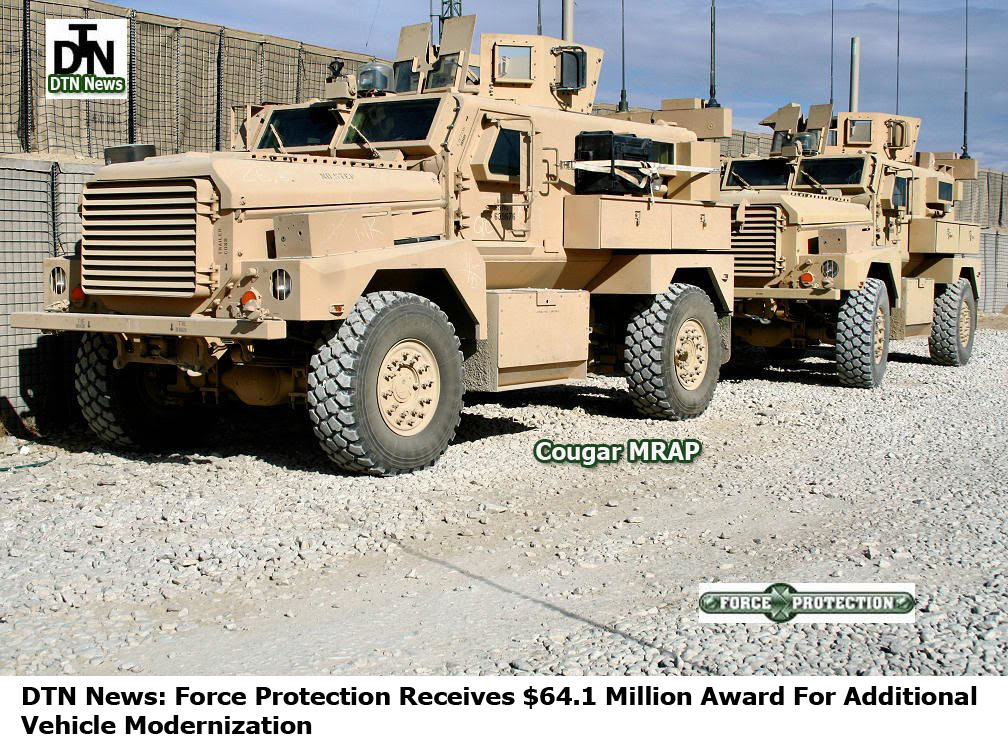
DTN News: Force Protection Receives $64.1 Million Award For Additional Vehicle Modernization

Defense News: DTN News: Force Protection Receives $64.1 Million Award For Additional Vehicle Modernization
(NSI News Source Info) LADSON, SC - August 23, 2010: Force Protection Industries, Inc., a wholly-owned subsidiary of Force Protection Inc. (NASDAQ:FRPT), a leading designer, developer and manufacturer of survivability solutions and provider of total life cycle support for those products, today announced that it has received a modification to existing contract M67854-07-D-5031 with an approximate value of $64.1 million for seat survivability upgrade kits for 1,946 Mine Resistant Ambush Protected Category I Cougar vehicles. The modification is subject to definitization. Work will be performed primarily in Afghanistan with additional work in Kuwait and home stations in the United States. All work under this modification is expected to be complete by February, 2011.
Randy Hutcherson, Chief Operating Officer for Force Protection Industries, Inc., said, “We are pleased to provide these seat upgrades to enhance the already significant survivability of the Cougar vehicle. This award represents an important milestone in our ongoing upgrade, sustainment and modernization efforts. As we continue to develop additional survivability enhancements we will work with our customers to implement those enhancements on our installed fleet of vehicles.”
About Force Protection, Inc.
Force Protection, Inc. is a leading designer, developer and manufacturer of survivability solutions, including blast- and ballistic-protected wheeled vehicles currently deployed by the U.S. military and its allies to support armed forces and security personnel in conflict zones. The Company’s specialty vehicles, including the Buffalo, Cougar and related variants, are designed specifically for reconnaissance and urban operations and to protect their occupants from landmines, hostile fire, and improvised explosive devices (“IEDs”, commonly referred to as roadside bombs). Complementing these efforts, the Company is designing, developing and marketing new vehicle platforms (including the Ocelot and JAMMA) that provide increased modularity, speed, mobility and concealment with enhanced levels of blast- and ballistic-protection. The Company also develops, manufactures, tests, delivers and supports products and services aimed at further enhancing the survivability of users against additional threats. In addition, the Company provides long-term life cycle support services of its vehicles that involve development of technical data packages, supply of spares, field and depot maintenance activities, assignment of highly-skilled field service representatives, and advanced on and off-road driver and maintenance training programs. For more information on Force Protection and its products and services, visit www.forceprotection.net.
Safe Harbor Statement
This press release contains forward looking statements that are not historical facts, including statements about our beliefs and expectations. These statements are based on beliefs and assumptions of Force Protection’s management, and on information currently available to management. These forward looking statements include, among other things: the growth, demand and interest for Force Protection’s services and vehicles, including the Cougar; expectations for future modernization and service-related contracts for the Cougar; the benefits and suitability of the Cougar, including its survivability enhancements; the ability to meet current and future requirements, including expected work completion dates; the Company’s execution of its business strategy and strategic transformation, including its opportunities to grow the business; and, the Company’s expected financial and operating results, including its revenues, cash flow and gross margins, for future periods. Forward-looking statements speak only as of the date they are made, and the Company undertakes no obligation to update any of them publicly in light of new information or future events. A number of important factors could cause actual results to differ materially from those contained in any forward-looking statements. Examples of these factors include, but are not limited to, ability to effectively manage the risks in the Company’s business; the ability to develop new technologies and products and the acceptance of these technologies and products; and, the other risk factors and cautionary statements listed in the Company’s periodic reports filed with the Securities and Exchange Commission, including the risks set forth in the Company’s Annual Report on Form 10-K for the year ended December 31, 2009 and as updated in the Quarterly Report on Form 10-Q for the quarter ended June 30, 2010.
*This article is being posted from Toronto, Canada By DTN News ~ Defense-Technology News, contact: dtnnews@ymail.com

DTN News: Boeing Joins ProActive Technologies Team In Bid for B-52 Aircrew Training System

Defense News: DTN News: Boeing Joins ProActive Technologies Team In Bid for B-52 Aircrew Training System
Source: DTN News / Boeing
(NSI News Source Info) ST. LOUIS, - August 23, 2010: The Boeing Company [NYSE: BA], along with teammate ProActive Technologies LLC of Orlando, Fla., has submitted a proposal for the U.S. Air Force's B-52 Training System Contractor Logistics Support (CLS) program. The contract provides program management and on-site CLS to operate, maintain, sustain, and upgrade training devices located at Barksdale Air Force Base, La., and Minot Air Force Base, N.D.
ProActive will be the prime contractor on the team, with Boeing's Global Services & Support division adding its extensive expertise in developing training devices and in maintaining, modifying, and upgrading the B-52 aircraft itself. The Air Force is expected to award the contract in March 2011.
"Our team can provide the customer with a proven low-risk approach that ensures reduced costs and superior operational performance," said Mark McGraw, Boeing vice president of Training Systems & Services. “ProActive has brought together industry-leading support, world-class training system capabilities, and proven aircraft Original Equipment Manufacturer expertise to ensure the warfighter is training on concurrent devices."
ProActive Technologies provides state-of-the-art hardware and software design engineering and logistical and management support services to the simulation and training marketplaces for government and private industry.
A unit of The Boeing Company, Boeing Defense, Space & Security is one of the world's largest defense, space and security businesses specializing in innovative and capabilities-driven customer solutions, and the world’s largest and most versatile manufacturer of military aircraft. Headquartered in St. Louis, Boeing Defense, Space & Security is a $34 billion business with 68,000 employees worldwide.
Contact:
Alma Dayawon
Boeing Communications
Office: 314-232-0389
Mobile: 312-835-2699

DTN News: Aerospace/Defense Headlines - News Dated August 23, 2010

Defense News: DTN News: Aerospace/Defense Headlines - News Dated August 23, 2010
Source: DTN News - - This article compiled by Roger Smith from reliable sources including latest updates Defense News, Aerospace/Defense Headlines - News & Yahoo
(NSI News Source Info) TORONTO, Canada - August 23, 2010: Comprehensive daily news related to Aerospace/Defense for the world of TODAY.

*Comprehensive daily news related on Aerospace/Defense for the world of TODAY.

Monday August 23, 2010

Saturday August 21, 2010

Friday August 20, 2010