Tuesday, April 13, 2010

Lockheed Martin To Host First Virtual Supplier Conference With Approximately 8,000 Companies And Small Business

Lockheed Martin - We never forget who we're working for

* Analysis: Lockheed Martin has created an immense dedication to develop and contribute to the U.S. economy by creating the system of hosting the First Virtual Supplier Conference 8,000 Companies and Small Businesses. By Defense News, contact defensenews@hotmail.com

Defense News: BETHESDA, Md., April 12th, 2010 -- Lockheed Martin [NYSE: LMT] will host its first virtual supplier conference today, with approximately 8,000 representatives from suppliers to Lockheed Martin participating via live Webcast. The virtual conference will replace a smaller, in-person conference and increase affordability, decrease travel and allow more businesses to participate.

“This virtual conference allows Lockheed Martin to talk directly with 8,000 of our largest suppliers about the company’s outlook, our commitment to ethics and business conduct, cyber-security and supply chain initiatives like green procurement,” said Reese Delorey, vice president of procurement for Lockheed Martin. “The corporation works with more than 80,000 suppliers and small businesses each year that help us provide agile, cost-effective global security solutions to our customers.”

Lockheed Martin works with suppliers to ensure that all business interaction, products and services meet the highest standards of integrity, technology, affordability and sustainability.

Headquartered in Bethesda, Md., Lockheed Martin is a global security company that employs about 140,000 people worldwide and is principally engaged in the research, design, development, manufacture, integration and sustainment of advanced technology systems, products and services. The corporation reported 2009 sales of $45.2 billion.

Media Contact: Scott Lusk, 301-897-6934; cell 240-274-3554; e-mail,scott.lusk@lmco.com

Lockheed Martin Submits Littoral Combat Ship Proposal to U.S. Navy

Defense News: WASHINGTON, D.C., April 12th, 2010 -- The Lockheed Martin [NYSE: LMT]-led industry team submitted its proposal for the Littoral Combat Ship (LCS) fiscal year 2010-2014 contract to the U.S. Navy today.Lockheed Martin is one of two industry teams competing for the contract.
The Navy will award the winning team a fixed-price incentive fee contract to provide up to 10 ships as well as combat systems for five additional ships. Two of the 10 ships would be acquired in fiscal 2010 and the rest via options through fiscal 2014


“We are offering the U.S. Navy a low-risk, affordable design that has already proven itself essential to the expanding challenges faced by our Sailors,” said Lockheed Martin Chairman and CEO Bob Stevens. “Lockheed Martin is committed to continuing our strong performance to ensure delivery of an affordable class of LCS ships for our nation.”

The Navy awarded the Lockheed Martin team a fixed-price incentive fee contract in March 2009 to build the Navy’s third LCS. LCS 3, the Navy’s future USS Fort Worth, is being built in Marinette, WI, with all of the ship’s modules currently under construction and nearly 40 percent of the ship complete.

Lockheed Martin’s first LCS, USS Freedom, was delivered to the Navy in 2008. In February, it began its maiden deployment approximately two years ahead of schedule. Since then, the ship has conducted a series of drug interdictions in which the crew seized more than five tons of cocaine.

Headquartered in Bethesda, Md., Lockheed Martin is a global security company that employs about 140,000 people worldwide and is principally engaged in the research, design, development, manufacture, integration and sustainment of advanced technology systems, products and services. The Corporation reported 2009 sales of $45.2 billion.

Media Contact at Lockheed Martin: Kim Martinez, (202) 863-3491;

e-mail:kimberly.martinez@lmco.com

Lockheed Martin Completes First Live Tracking Exercise with New Multi-Mission, Open Architecture Aegis Signal Processor

Defense News: MOORESTOWN, N.J., April 12th, 2010 -- Lockheed Martin [NYSE: LMT] successfully identified and tracked numerous live targets for the first time using its new Multi-Mission Signal Processor (MMSP). The MMSP is intended to help combine next-generation Aegis Ballistic Missile Defense and Anti-Air Warfare capabilities in an open combat system architecture for the U.S. Navy.
EN0084-60-06.17.jpg

“By combining the proven SPY-1 radar and Aegis Ballistic Missile Defense signal processing capability, we will provide cost-effective and space-efficient warfighting improvements for the U.S. Navy,” said Allan Croly, director, Naval Radar Programs, for Lockheed Martin’s Mission Systems and Sensors business unit.

The augmented Aegis system detected air tracks at the Navy’s land-based test facility, the Vice Admiral James H. Doyle Combat Systems Engineering Development Site in New Jersey. Additional testing will occur throughout 2010. As part of the Aegis Modernization Program, MMSP is scheduled for installation on guided missile destroyers currently equipped with the Aegis Weapon System. The MMSP installations will begin in 2012.

The road to Aegis Open Architecture has included extensive systems engineering to reconfigure the Aegis system to allow frequent technology refreshes and the ready acceptance of capability upgrades, whether they are accomplished via new development or the integration of third-party-developed products.

The 92 Aegis-equipped ships currently in service around the globe have more than 950 years of at-sea operational experience and have launched more than 3,500 missiles in tests and real-world operations. In addition to the United States, Aegis is the maritime weapon system of choice for Australia, Japan, Norway, South Korea and Spain.

Headquartered in Bethesda, Md., Lockheed Martin is a global security company that employs about 140,000 people worldwide and is principally engaged in the research, design, development, manufacture, integration and sustainment of advanced technology systems, products and services. The corporation reported 2009 sales of $45.2 billion.

Media Contact:
Kathy Baier 856-722-3006; 609-472-7954 (cell)
Kathleen.m.baier@lmco.com


Lockheed Martin Delivers the 1,000TH Joint Air-To-Surface Standoff Missile to the U.S. Air Force

Defense News: ORLANDO, FL, April 12th, 2010 -- Lockheed Martin’s [NYSE: LMT] Joint Air-to-Surface Standoff Missile (JASSM) program team has delivered its 1,000th missile to the U.S. Air Force. The missile was completed as part of the seventh production lot at the Lockheed Martin Missiles and Fire Control facility in Troy, AL.

Joint Air-to-Surface Standoff Missile Information

JASSM Photo 1

Joint Air-to-Surface Standoff Missile (JASSM)

The JASSM (Joint Air-to-Surface Standoff Missile) is an autonomous, long-range, conventional, air-to-ground, precision standoff missile for the U.S. Air Force and Navy. JASSM is designed to destroy high-value, well-defended, fixed and relocatable targets. JASSM's significant standoff range keeps Air Force and Navy aircrews well out of danger from hostile air defense systems. The missile's mission effectiveness approaches single-missile target kill capability. With this superior performance and affordable price, JASSM offers the best value of any weapon in its class.

Missile number 1,000 was completed seven years after the first missile was delivered, almost to the month. This achievement was acknowledged in a rollout ceremony at the Troy facility,
with participants including U.S. Air Force Program Office officials, U.S. Air Force Air Combat Command representatives, Australian Department of Defence officials, Defense Contract Management Agency officials and Lockheed Martin team members.

“This milestone shows the resolve of Lockheed Martin employees to deliver top quality products to our customers,” said Alan Jackson, JASSM program director at Lockheed Martin Missiles and Fire Control. “Working with our customers, we've overcome challenges, accommodated new requirements and are delivering a precision weapon that provides unparalleled capabilities to U.S. and allied Warfighters."

JASSM is a critical weapon for the U.S. Air Force, with the eighth production lot under contract toward a total objective of 4,900 JASSMs and JASSM-ERs (Extended Range). The baseline JASSM is also produced for foreign military sale customers. JASSM’s can be integrated on multiple aircraft and have been successfully demonstrated on the B-1, B-2, B-52 and F-16 aircraft. Future platforms include the F-15E, F/A-18 and F-35.

The missile is produced at Lockheed Martin’s award-winning manufacturing facility in Troy, AL. Lockheed Martin has assembled JASSM missiles in Troy, for testing and operational use, since late 1999. A 2,000-pound class weapon with a penetrator/blast fragmentation warhead, JASSM cruises autonomously in adverse weather, day or night, using a state-of-the-art infrared seeker in addition to the anti-jam GPS to find a specific target aimpoint. Its stealthy airframe makes it extremely difficult to defeat.

Headquartered in Bethesda, Md., Lockheed Martin is a global security company that employs about 140,000 people worldwide and is principally engaged in the research, design, development, manufacture, integration and sustainment of advanced technology systems, products and services. The Corporation reported 2009 sales of $45.2 billion.

Janina Rivera, (407) 356-5919
e-mail
janina.m.rivera@lmco.com


DTN News: Boeing, Air Force, Air National Guard Roll Out 1st Operational F-15C With Enhanced Radar

Defense News: DTN News: Boeing, Air Force, Air National Guard Roll Out 1st Operational F-15C With Enhanced Radar
Source: DTN News / Boeing
(NSI News Source Info) JACKSONVILLE, Fla., - April 13, 2010: Boeing [NYSE: BA] representatives joined the U.S. Air Force and Florida Air National Guard (ANG) in Jacksonville today to roll out the first operational ANG F-15C equipped with an Active Electronically Scanned Array (AESA) radar. Boeing is under contract to upgrade 14 ANG and 10 Air Force F-15C/D aircraft with AESA.
The Raytheon APG-63(V)3 AESA radar being installed on the F-15s combines the operationally proven APG-63(V)2 software with the advanced APG-79 Transmit/Receive hardware found on the F/A-18E/F Super Hornet. It is a reliable and affordable high-performance AESA for the F-15 air-to-air variant. The AESA radar antenna is 50 times more reliable than the mechanically scanned antenna it replaces.
“The (V)3 AESA radar will greatly improve F-15 pilots’ situational awareness, beyond-visual-range targeting, and weapon accuracy,” said Jim Means, director of Proprietary Programs for Boeing Global Strike Systems. “The new radar also enhances the capability to find and track small targets at low altitude -- a capability the ANG will employ in its Homeland Defense Air Sovereignty role. The addition of a built-in test function on the AESA antenna makes the (V)3 easier to maintain.”
The APG-63(V)3 radar is the latest in a series of planned upgrades that will ensure the F-15C’s combat-proven air supremacy well into the 21st century. These include a fighter-to-fighter data link, GPS navigation and the Joint Helmet Mounted Cueing System, enabling the fighter to conduct network centric operations while employing the latest air-to-air weapons.
Boeing Global Services & Support provides sustainment services for the Air Force F-15 fleet, including spares and retrofit programs, field service teams and a full range of training systems and services.
A unit of The Boeing Company, Boeing Defense, Space & Security is one of the world’s largest defense, space and security businesses specializing in innovative and capabilities-driven customer solutions, and the world’s largest and most versatile manufacturer of military aircraft. Headquartered in St. Louis, Boeing Defense, Space & Security is a $34 billion business with 68,000 employees worldwide.

DTN News: Boeing to Provide Next-Generation GPS Ground Systems Support To US Air Force

Defense News: DTN News: Boeing to Provide Next-Generation GPS Ground Systems Support To US Air Force
Source: DTN News / Boeing
(NSI News Source Info) AURORA, Colo., - April 13, 2010: Boeing [NYSE: BA] April 12., announced that, as part of the Raytheon team awarded the space-based Global Positioning System (GPS) advanced control segment program (OCX), it will develop portions of the U.S. Air Force's new ground control segment. GPS OCX will provide more secure, accurate, and precise navigation around the world for military, humanitarian and commercial applications.
The development contract, awarded recently by the Air Force Space and Missile Systems Center's GPS Wing, is valued at more than $880 million over six years, including five option years for sustainment.
Boeing has provided ground operations sustainment support for the current GPS II fleet for nearly a decade. Under GPS OCX, the company will provide infrastructure, development of the ground systems, and continued 24/7 operational and sustainment support for the current and future GPS satellite systems. The company will install hardware and software at GPS control stations at Schriever Air Force Base in Colorado and Vandenberg Air Force Base in California.
"This award demonstrates the Air Force's confidence in our solution," said Sparky Olsen, director of Boeing Intelligence and Security Systems Mission Operations. "We will deliver a solution that provides enhanced operational capabilities to warfighters and other users while demonstrating Boeing's efficiencies and innovation with responsive operations and sustainment." GPS OCX will replace the current GPS Operational Control System while maintaining backward compatibility with the Block IIR and IIR-M constellation, providing command and control of the new GPS IIF and GPS III families of satellites, and enabling new, modernized signal capabilities.
A prime contractor for GPS satellites for more than three decades, Boeing is currently under contract to build 12 GPS Block IIF satellites. GPS IIF is the product of Boeing's experience with 39 successful satellites from the GPS Block I and Block II/IIA missions and more than 30 years of teamwork with the Air Force. GPS IIF will form the core of the GPS constellation for many years to come.
A unit of The Boeing Company, Boeing Defense, Space & Security is one of the world's largest defense, space and security businesses specializing in innovative and capabilities-driven customer solutions, and the world's largest and most versatile manufacturer of military aircraft. Headquartered in St. Louis, Boeing Defense, Space & Security is a $34 billion business with 68,000 employees worldwide.

DTN News: U.S. Department of Defense Contracts Dated April 12, 2010

Defense News: DTN News: U.S. Department of Defense Contracts Dated April 12, 2010
Source: U.S. DoD issued April 12, 2010
(NSI News Source Info) WASHINGTON - April 12, 2010: U.S. Department of Defense, Office of the Assistant Secretary of Defense (Public Affairs) Contracts issued April 12, 2010 are undermentioned;
CONTRACTS
NAVY

~Lockheed Martin Corp., Maritime Systems and Sensors, Manassas, Va., is being awarded a $58,605,221 not-to-exceed, cost-plus-incentive-fee letter contract for the design and manufacture of hardware for the Acoustic Rapid commercial-off-the-shelf Insertion (A-RCI) system improvement and integration program. The contract provides funding for the development and production of the A-RCI and common acoustics processing for Technology Insertion 08 through Technology Insertion 10 for the submarine fleet and for Foreign Military Sales. This contract combines purchases for the U.S. Navy (98.2 percent) and the government of Canada (1.8 percent) under the Foreign Military Sales program. Work will be performed in Clearwater, Fla. (60 percent), and Manassas, Va. (40 percent), and is expected to be completed by October 2011. Contract funds will not expire at the end of the current fiscal year. This contract was not competitively procured. The Naval Sea Systems Command, Washington Navy Yard, D.C., is the contracting activity (N00024-10-C-6266).
~FN Manufacturing, LLC, Columbia, S.C., is being awarded an $11,500,000 firm-fixed-priced, indefinite-delivery/indefinite-quantity contract for refurbishing and overhauling of machine guns in support of multiple military agencies. The MK 46 lightweight machine gun (LMG), MK 48 LMG, and the M240 machine gun will be refurbished and or overhauled to a like new condition so the aforementioned weapons can be used in combat. The MK 46 LMG, MK 48 LMG, and the M240 machine gun will be used to support a wide array of U.S. Armed Forces missions. Work will be performed in Columbia, S.C., and is expected to be completed by April 2015. Contract funds in the amount of $315,056 will expire at the end of the current fiscal year. This contract was awarded on a sole-source basis with the solicitation being publicized on the Federal Business Opportunities Web site. Naval Surface Warfare Center, Crane Division, Crane, Ind., is the contracting activity (N00164-10-D-JN09).
AIR FORCE
~Booz Allen & Hamilton, Inc., Herndon, Va., was awarded a $19,836,983 contract which will provide major research collaboration between laboratory telecommunications sciences researchers, the University of Maryland faculty, and other academic institutions in the areas of secure networking, high bandwidth telecommunications, and information assurance. At this time, $1,508,479 has been obligated. 55 CONS, Offutt Air Force Base, Neb., is the contracting activity (SP0700-98-D-4002).
~EDO Defense Systems, Amityville, N.Y., was awarded a $19,615,175 contract which will exercise an option to provide for the repair of AN/ALQ-161A radio frequency surveillance/electronic countermeasures system components. At this time, no money has been obligated. 448 SMG/PKHCB, Robins Air Force Base, Ga., is the contracting activity (FA8522-09-D-0006, P00002).
~Booz Allen & Hamilton, Inc., Herndon, Va., was awarded a $14, 488,466 contract which will provide for the stand-up of a new command center for executing U.S. Cyber Command initiatives while continuing to execute its mission essential tasks for a robust, secure global information grid under the President’s National Cyber Initiative. At this time, $297,619 has been obligated. 55 CONS/LGCD, Offutt Air Force Base, Neb., is the contracting activity (SP0700-98-D-4002).
~Axsys Technologies, Nashua, N.H., was awarded a $5,999,000 contract which will provide for seven high definition spot camera systems in support of the Air Force Research Laboratory’s Angel Fire program. At this time, the entire amount has been obligated. 88 CONS, Wright-Patterson Air Force Base, Ohio, is the contracting activity (FA8601-10-C-0031).

Monday, April 12, 2010

EADS Back in Play for the KC-X, the Aerial Tanker That Just Can't Get off the Ground

Defense News: (By Matthew Potter) When Northrop Grumman (NOC) announced in March that it would not bid for the new aerial tanker for the U.S. Air Froce, the KC-X,Boeing (BA) and its many supporters in Congress believed it was sure to get the $35 billion contract. Now the deadline to bid has been extended 60 days to allow the European aerospace giant,EADS (EADS:P), to submit a proposal.


There are already reports that EADS, which would seek to provide A330 airliners made by its subsidiary,
Airbus, to be modified into the tankers, is talking to other defense contractors about partnering. The addition of an experienced, preferably American, company could mitigate some of the issues facing EADS with leading a contract of this size for the U.S. military. The company has not had many major contracts to date with the Pentagon.

Considering that it has taken more than eight years and two aborted tries to award a contract, another two-month delay is minor. To Boeing and its supporters, though, it is unnecessary and seems to be a reflexive response to the French President’s recent visit to the White House and his pointed criticism of the current situation. Boeing is still confident that it will win the contract as its proposal, based on the smaller KC-767, meets the requirements better, which is why Northrop backed out.

If EADS and a new partner do submit a winning bid, the immediate result could be protest, litigation and more delays. The program now looks at getting new aircraft in 2011-15. Under the original lease plan from 2002, there should have been new aircraft flying now and the aging KC-135 heading to the boneyard.

Both Boeing and Airbus would love to get the work as the world’s airline business is still recovering from the recession. This contract would provide needed revenue and also subsidize the construction of a facility in the southern U.S. that could compete with lower labor costs to its existing plants in France and Germany. Boeing is building a plant in South Carolina.

A competitive contract is almost always preferable to a sole-source one. But if EADS fails to bid, or if its bid is unsuitable, all that will have resulted from this decision is one more delay to this critical program.


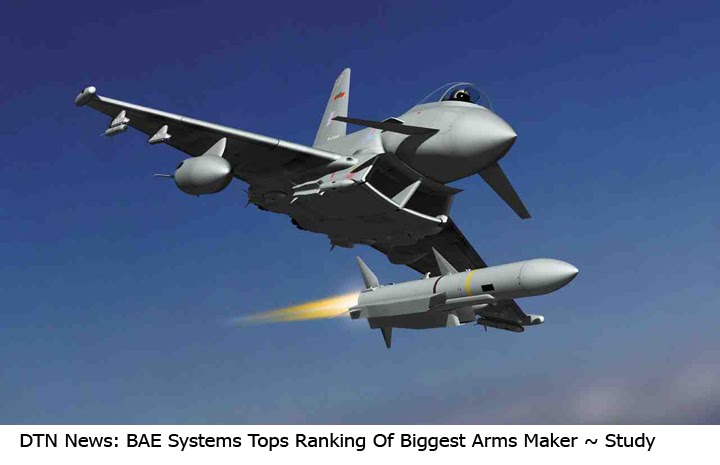
DTN News: BAE Systems Tops Ranking Of Biggest Arms Maker ~ Study

Defense News: DTN News: BAE Systems Tops Ranking Of Biggest Arms Maker ~ Study
Source: DTN News / AFP
(NSI News Source Info) STOCKHOLM - April 12, 2010: BAE Systems topped an international ranking of the world's biggest arms groups, becoming the first non-US company to hold the spot, a leading defence think tank said on Monday.
The group knocked US defence giant Boeing out of the top position in 2008, according to the ranking of biggest defence groups worldwide tallied by the Stockholm International Peace Research Institute (SIPRI).
"The main reason that BAE became the largest arms-producing company in the world in 2008 is the increase in its US sales, which outpaced decreases elsewhere including in the UK," the think tank said in the study.
With arms sales in 2008 of 18.9 billion pounds, Boeing fell from first place in 2007 to third following BAE Systems with 20.98 billion pounds and US group Lockheed Martin with 19.36 billion pounds.
It was followed by three US groups -- Northrop Grumman, General Dynamics and Raytheon -- ahead of European group EADS in seventh place, Italian company Finmeccanica in eighth, L-3 Communications in ninth and Thales of France in tenth position.
The biggest Russian group on the list, air defence systems maker Almaz-Antei, was number 18 on the list.
In 2008 the 100 biggest defence groups had arms sales of 249 billion pounds, up 11 percent from the previous year, according to SIPRI.
"This is more than three times the size of the total development aid of OECD countries in 2008," SIPRI said, noting that such aid reached 77.73 billion pounds.
Putting the data in perspective, the think tank said that arms sales of Lockheed Martin alone topped US development aid by four billion dollars and that BAE Systems sales were greater than the gross domestic product of 105 countries.
SIPRI's ranking focuses on companies' arms sales which make up only 48 percent of Boeing's turnover and 70 percent of Lockheed Martin's revenues.
In BAE System's case, arms sales make up a far larger share of its sales with 95 percent of the total.
Born out of the merger of Marconi and British Aerospace in 1999, BAE Systems counts among its products the Eurofighter combat aircraft, the Bradley tank and the Astute submarine.
With 59 percent of BAE Systems' sales coming from the vast US arms market, the group has major production operations in the country as well as in Britain, Sweden, South Africa and Sweden.
"BAE really shows the increasing internationalisation of the arms industry and the attractiveness of the US market," SIPRI arms industry expert Susan Jackson said.
The group has benefitted from sales of mine-resistant, ambush-protected (MRAP) vehicles to the US government for the wars in Afghanistan and Iraq.

DTN News: Kuwaiti MPs Warn Of Grilling Over French Jets

Defense News: DTN News: Kuwaiti MPs Warn Of Grilling Over French Jets
Source: DTN News / By Omar Hasan (AFP)
(NSI News Source Info) KUWAIT CITY - April 12, 2010: An Islamist bloc in Kuwait's parliament opposed to a planned purchase of French-made Rafale warplanes on Sunday warned it will grill senior officials if the deal is signed.
"Signing the purchase agreement means we will grill whoever is responsible for authorising the deal," spokesman for the Reform and Development Bloc Faisal al-Muslim told a press conference.
He would not say, however, whether the prime minister or defence minister are among the officials the bloc plans to call to account if the multi-billion-dollar deal to purchase between 14 and 28 Rafale jets goes ahead.
Another of the bloc's MPs, Jamaan al-Harbash, who has campaigned against the deal for several months, produced what he said were documents from the defence ministry recommending that the purchase be dropped.
"The reports concluded that the plane is not technically advanced, its price is very expensive and so are its spare parts. If it goes ahead, the deal will be a massive squandering of public funds," Harbash said.
Both Muslim and Harbash insisted that their opposition to the deal had nothing to do with any animosity against France.
MP Mussallam al-Barrak, spokesman for the opposition four-MP Popular Action Bloc, later declared total support for any political questioning over the Rafale deal.
The visiting chief of staff of the French armed forces, Admiral Edouard Guillaud, defended the Rafale as one of the best warplanes in the world, saying negotiations over the deal are proceeding in complete transparency.
"France has proposed that Kuwait replace the old Mirage jets with the advanced Rafale and the Kuwaiti government asked to study the offer," Guillaud was quoted as saying by the official KUNA news agency.
Guillaud said Kuwait has sent experts to France for a close assessment of the jets, adding that Paris will also make a proposal to sell the plane to the United Arab Emirates.
The Popular Action Bloc has been campaigning against several proposed arms deals, including the Rafale purchase.
Last month, Defence Minister Sheikh Jaber Mubarak al-Sabah said the Rafale deal remained a priority for Kuwait.
In November, the emirate's parliament voted unanimously to ask the independent Audit Bureau to probe three planned arms deals with the United States and France that one lawmaker said were worth billions of dollars.
The deals include the planned purchase of an unspecified number of US-made Hercules transport aircraft and an ammunition factory, as well as the Rafale fighters.
But Muslim said on Sunday that the accounts watchdog told parliament that it was unable to carry out the probe because the defence ministry failed to provide it with the necessary documents.
In October, Kuwait and France signed a new defence agreement and discussed details of the Rafale deal.
During a Gulf tour in February 2008, French President Nicolas Sarkozy said discussions had begun with Kuwait on the sale of between 14 and 28 Rafales, which are made by France's Dassault Aviation.

DTN News: Boeing Completes Site Acceptance Testing Of Australia's Network Centric Command And Control System

Defense News: DTN News: Boeing Completes Site Acceptance Testing Of Australia's Network Centric Command And Control System
Source: DTN News / Boeing
(NSI News Source Info) BRISBANE, Queensland, - April 12, 2010: Boeing Defence Australia, a wholly owned subsidiary of The Boeing Company [NYSE: BA], today announced that Project Vigilare, a Network Centric Command and Control System (NC3S) solution for the Royal Australian Air Force (RAAF), has passed Site Acceptance Testing at the Northern Regional Operational Centre (NROC) located at RAAF Base Tindal, Northern Territory.
"The Site Acceptance Test verifies Vigilare, as installed at the NROC site, is able to interface with all the relevant external systems and is ready for operational testing," said Arthur Mamalis, Boeing Defence Australia program director for Project Vigilare. "This shows that we continue to make significant strides toward delivering Vigilare's full operational capability to our RAAF customer."
The system successfully demonstrated its ability to manage multiple datalinks concurrently from the site by using assets deployed over a vast geographic area, both in the Northern Territory and the East Coast of Australia. These datalinks connected test assets as well as operational assets such as RAAF F/A-18 Hornet aircraft.
"With data feeds from more than 45 different sensors and agencies using an enhanced Department of Defence communications network, the Vigilare Site Acceptance Test demonstrated an integrated, high-fidelity command and control system capability," said Tim Malone, Defence Materiel Organisation project director for Project Air 5333 Vigilare. "This is the culmination of many years of hard work by operational specialists, engineers and logisticians to build a system that arguably will be the benchmark for Network Centric Warfare systems in the Australian Defence Force for some time."
Operational testing with the RAAF is scheduled to begin in June, before Vigilare is accepted at NROC by the Commonwealth of Australia.
"This milestone was a direct result of the commitment and dedication of our employees, our program partners and the customer," said Steve Parker, Boeing vice president and general manager of Network and Space Systems - Australia. "The overriding success of the test demonstrated the advanced capabilities Vigilare provides and allows the team to prepare for operational testing."
Developed by Boeing Defence Australia, NC3S integrates advanced technologies that combine data from land, sea, air and space platforms, sensors, data links and intelligence agencies to provide tactical and strategic-level surveillance and battlespace management operations across wide geographic regions.
Boeing Defence Australia, a wholly owned subsidiary of The Boeing Company and a business unit of Boeing Defense, Space & Security, is a leading Australian aerospace enterprise. With a world-class team of nearly 2,000 employees at 13 locations throughout Australia and two international sites, Boeing Defence Australia supports some of the largest and most complex defense projects in Australia.
A unit of The Boeing Company, Boeing Defense, Space & Security is one of the world's largest defense, space and security businesses specializing in innovative and capabilities-driven customer solutions, and the world's largest and most versatile manufacturer of military aircraft. Headquartered in St. Louis, Boeing Defense, Space & Security is a $34 billion business with 68,000 employees worldwide.

DTN News: Washington Nuclear Summit Under Way

Defense News: DTN News: Washington Nuclear Summit Under Way
Source: DTN News / Int'l Media
(NSI News Source Info) WASHINGTON - April 12, 2010: Leaders and representatives from 47 nations have gathered for a nuclear security summit in Washington as Barack Obama, the US president, pledges to one day rid the world of nuclear weapons.
Obama is expected to tell delegates at Monday's conference that the biggest threat to global security has shifted from the possibility of confrontation between nuclear armed states, to the fear that "terrorist" groups might acquire atomic weapons.
"The single biggest threat to US security, both short-term, medium-term and long-term, would be the possibility of a terrorist organization obtaining a nuclear weapon," Obama said at meetings with world leaders on Sunday.
"We know that organisations like al-Qaeda are in the process of trying to secure nuclear weapons or other weapons of mass destruction, and would have no compunction at using them."
Concrete commitments
Obama set a goal of ensuring all nuclear materials worldwide are secured from theft or diversion within four years.
The White House will seek concrete commitments from world leaders on securing stockpiles of separated plutonium and uranium, to ensure that they cannot be stolen, smuggled or sold.
"I feel very good at this stage in the degree of commitment and sense of urgency that I've seen from the world leaders so far on this issue," Obama said.
"We think we can make enormous progress on this."
The summit will focus primarily on separated plutonium and highly enriched uranium stocks, rather than radiological "dirty" bombs, which the US sees as a less catastrophic threat than nuclear devices.
US officials hope nations participating in the summit will agree on a series of security steps for their own nuclear material, and help pay to put the stocks of less well-off countries under lock and key.
They also expect some leaders to unveil specific actions, similar to Chile's decision to ship a stock of highly enriched uranium to the US.
Binyamin absent
Iran and North Korea were not invited to the conference. The US believes that Iran is attempting to build a nuclear weapon in violation of the global nuclear non-proliferation treaty, and it objects to North Korea's nuclear weapons stockpile and exports of nuclear materials and technology.
Binyamin Netanyahu, the Israeli prime minister, will not attend the conference and is expected to send Dan Meridor, the deputy prime minister, in his place.
Insiders said Netanyahu was worried Turkey and Egypt would use the summit to challenge him over his country's nuclear arsenal, which Israel has never officially acknowledged.The two countries planned to demand that Israel sign up to the 1970 Non-Proliferation Treaty (NPT).
The conference is the fourth leg of Obama's campaign to rid the world of nuclear weapons, which began a year ago in Prague, in the Czech Republic, when he laid out plans for significant nuclear reductions.
Last week Obama approved a new nuclear policy for the US vowing to reduce its' nuclear arsenal, refrain from nuclear tests and not use nuclear weapons against countries that do not have them.
North Korea and Iran were not included in the pledge.
Also last week Obama and Dmitri Medvedev, the Russian president, signed a new START treaty that reduces each side's deployed nuclear arsenal to 1,550 weapons.
The conference is a precursor to the United Nation's Non-Proliferation Treaty review conference next month, seen as another important moment in heading off a future nuclear arms race.

Lockheed Martin Backs Year of Nano at Rice

Lockheed Martin - We never forget who we're working for

Birthplace of nanotechnology to host gala, symposium, sculpture garden


Defense News: BETHESDA, Md., April 12, 2010 -- Lockheed Martin [NYSE: LMT] and Rice University are celebrating the 25th anniversary of a breakthrough that has advanced technology in fields from medicine to baseball. Lockheed Martin is sponsoring the Year of the Nano, Rice’s celebration of the Nobel Prize-winning discovery of the buckminsterfullerene molecule – the “buckyball” – that enables nanotechnology.

The buckyball, a perfect, soccer ball-shaped molecule of 60 carbon atoms, is one of the toughest materials in nature. Its discovery in 1985 by Nobel Prize winners Richard Smalley and Robert Curl of Rice and Harold Kroto of Florida State University, along with Rice researchers James Heath and Sean O'Brien, kicked off an era of nanotech research.

“Nano is revolutionizing modern technology just as plastics did generations ago,” says Dr. Ray O Johnson, Senior Vice President and Chief Technology Officer at Lockheed Martin. “As a global security company, Lockheed Martin looks to our scientists and engineers to come up with innovative solutions for the future. In so many ways, nanotechnology is that future. That’s why we are proud to partner with Rice on this event.”

Lockheed Martin and Rice already share a unique and productive partnership on the cutting edge of nanotechnology: the Lockheed Martin Advanced Nanotechnology Center of Excellence at Rice (LANCER) in Houston. LANCER is where some of the top researchers in academia tackle the high-tech industry’s toughest problems. The goal of the facility is to get nanotechnology out of the lab and into our lives.

The Year of Nano, presented by Lockheed Martin, will include a series of events throughout 2010 capped by a symposium in October that will bring to campus some of the biggest names in carbon nanotechnology research. Curl, Kroto, Heath, and O'Brien will talk about their discovery and the subsequent development of nanotechnology into the focal point of researchers around the world. Smalley died in 2005.

The symposium week begins on October 10 with the 10-10-10 Gala, hosted by Rice's Richard E. Smalley Institute for Nanoscale Science and Technology. The event will celebrate the history of nanotechnology at Rice and support the future of a field that has the potential to remake the energy industry, medical care, materials science, and more.

"The Smalley Institute is grateful to Lockheed Martin for helping us put on the Year of Nano in a way that the 25th anniversary of the buckyball deserves," says Wade Adams, the institute's director. “Thanks to Lockheed’s support, we can do a high-caliber symposium as well as many other events that will display Rice’s pioneering role and leadership in the field of nanotechnology.”

The symposium will feature talks by a number of nanotechnology pioneers, including Andreas Hirsch, Organic Chemistry Chair at the Friedrich-Alexander-Universität Erlangen-Nürnberg; Phaedon Avouris, an IBM Fellow and manager of Nanometer Scale Science and Technology at the IBM Thomas J. Watson Research Center in New York; Hongjie Dai, the J.G. Jackson-C.J. Wood Professor of Chemistry at Stanford University; Millie Dresselhaus, Institute Professor and professor of physics and electrical engineering at the Massachusetts Institute of Technology; Marvin Cohen, University Professor at the University of California-Berkeley and a senior faculty scientist at Lawrence Berkeley National Laboratory; Andre Geim, professor of condensed matter physics at the University of Manchester; Morinobu Endo, professor of electrical and electronic engineering, Faculty of Engineering at Shinshu University and Donald Huffman, professor emeritus of physics at the University of Arizona.

Headquartered in Bethesda, Md., Lockheed Martin is a global security company that employs about 140,000 people worldwide and is principally engaged in the research, design, development, manufacture, integration and sustainment of advanced technology systems, products and services. The corporation reported 2009 sales of $45.2 billion.

Media Contact: Thad Madden, 301-897-6833 e-mail,thad.madden@lmco.com

Lockheed Martin's F-35C Lightning II Carrier Variant Undergoes Drop Testing

Defense News: Dallas, Texas, April 12th, 2010 -- Lockheed Martin's F-35C Lightning II carrier variant ground-test article, CG-1, undergoes drop testing at Vought Aircraft in Dallas – one of 53 tests planned for CG-1 at Vought. On March 27,CG-1,was dropped 95 inches at 20 feet per second, with an 8.8-degree pitch, 2-degree roll, and 133-knot wheel speed, simulating a carrier-deck landing. During the testing, 500 sensors are monitored, with 2,500 points collected per second. The F-35C will be the Navy's first stealth fighter. In addition to ground testing, flight test continues, with more than 170 test flights logged. During the first quarter of 2010, the three F-35B test aircraft at Naval Air Station Patuxent River, Md., outperformed flight test requirements, completing 33 flights compared to the 29 required. Twenty-eight of the flights took place at Patuxent River, with the remaining five conducted from Lockheed Martin’s Fort Worth plant.


F-35C Lightning II Carrier Variant Undergoes Drop Testing at Vought Aircraft in Dallas.


Media Contacts:

Chris Geisel
Office: 817-763-2643
Email:
christian.g.geisel@lmco.com

John Kent
Office: 817-763-3980
Email:
john.r.kent@lmco.com


EADS says no decision yet on U.S. tanker bid

Defense News: PARIS (Reuters) - The chief executive of Airbus parent EADS (Paris:EAD.PA - News) said on Monday the European group had not yet decided whether to challenge Boeing (NYSE:BA - News) for a deal worth up to $50 billion to sell aerial tankers to the United States.

Trade visitors visit the EADS display area at the Singapore Airshow February 2, 2010. REUTERS/Tim Chong

Trade visitors visit the EADS display area at the Singapore Airshow February 2, 2010. REUTERS/Tim Chong

Louis Gallois told LCI Television in an interview to be broadcast later on Monday that any bid would be at a reasonable price and he ruled out going ahead with a loss-making proposal merely in order to pull off a strategic coup.

Gallois also said EADS was seeking a U.S. partner to handle sensitive electronics work and confirmed talks with L-3 Communications (NYSE:LLL - News) and Raytheon (NYSEArca:RTR - News) as well as others.

A tape of his remarks was made available ahead of their scheduled transmission in France at 1820 GMT.

EADS is mulling whether to take the lead on a new bid afterNorthrop Grumman (NYSE:NOC - News), its lead partner on an earlier successful bid which was overturned on an appeal fromBoeing, decided to quit the race to re-equip the U.S. tanker fleet.

(Reporting by Tim Hepher; Editing by James Regan)


SAIC Awarded Contract to Support Naval Air Systems Command


Company to Provide Professional and Analytical Support Services to NAVAIR's Corporate Operations and Comptroller Offices

Defense News: MCLEAN, Va., April 12 /PRNewswire-FirstCall/ -- Science Applications International Corporation (SAIC) (NYSE:SAI - News) today announced it has been awarded a contract by the Naval Air Warfare Center Aircraft Division (NAWCAD) to support the Naval Air Systems Command (NAVAIR) Corporate Operations and Comptroller Offices with a full range of organizational and business services. The multiple award, indefinite-delivery/indefinite-quantity contract has a one-year base period of performance, four one-year options and a ceiling value of $84 million for all awardees. Work will be performed in Patuxent River, Md. and at NAVAIR sites as required.

NAVAIR's Corporate Operations and Comptroller Office serves the U.S. Navy by providing a wide variety of business services to other competencies, commanding officers, site managers, and integrated project/program/enterprise teams. Under the contract, SAIC will provide professional and analytical support services to NAVAIR, as required, by defining and helping establish commercial business best practices to enable the NAVAIR Team to enhance performance and reduce costs. SAIC will also provide support in areas including management; organizational and business improvement; financial and business solutions; and human resources.

"We look forward to continuing our support of this important customer by helping NAVAIR enhance the support they provide to Naval warfighters including program management, strategic planning, and analytical and reporting capability services," said Debbie James, SAIC senior vice president and business unit general manager.

About SAIC

SAIC is a FORTUNE 500® scientific, engineering, and technology applications company that uses its deep domain knowledge to solve problems of vital importance to the nation and the world, in national security, energy and the environment, critical infrastructure, and health. The company's approximately 45,000 employees serve customers in the U.S. Department of Defense, the intelligence community, the U.S. Department of Homeland Security, other U.S. Government civil agencies and selected commercial markets. Headquartered in McLean, Va., SAIC had annual revenues of $10.8 billion for its fiscal year ended January 31, 2010. For more information, visit www.saic.com. SAIC: From Science to Solutions®

Statements in this announcement, other than historical data and information, constitute forward-looking statements that involve risks and uncertainties. A number of factors could cause our actual results, performance, achievements, or industry results to be very different from the results, performance, or achievements expressed or implied by such forward-looking statements. Some of these factors include, but are not limited to, the risk factors set forth in SAIC's Annual Report on Form 10-K for the period ended January 31, 2010, and other such filings that SAIC makes with the SEC from time to time. Due to such uncertainties and risks, readers are cautioned not to place undue reliance on such forward-looking statements, which speak only as of the date hereof.

Contact:

Melissa Koskovich

Laura Luke


(703) 676-6762

(703) 676-6533


Melissa.l.koskovich@saic.com

laura.luke@saic.com